A townhome roof can look perfectly normal from the parking lot. The shingles appear straight, the gutters are still attached, and there may not be a single stain on the ceiling during your showing.
But here is the question many buyers never ask:
What happens if the roof problem starts three doors down?
That is where townhome roofing becomes different.
Unlike a detached house, a townhome may share rooflines, drainage patterns, flashing transitions, structural connections, and maintenance responsibilities with neighboring units or a homeowners association. A leak showing up over your bedroom might originate near the adjoining property. A section that looks newer may have been repaired after a storm while the rest of the connected roof is significantly older. And depending on the community’s legal structure, the roof might be your responsibility, the association’s responsibility, or a combination of both.
That is why a townhome roof inspection Virginia Beach home buyers arrange should go beyond asking whether the shingles “look good.”
Yes, Townhome Roofs Really Can Require a Different Approach
A roof is a roof, right?
Structurally, many of the same basic inspection principles apply whether the property is detached or attached. A qualified inspector still wants to evaluate shingles or other roof coverings, flashing, penetrations, drainage, visible decking conditions, ventilation, and signs of leakage.
The difference is context.
With a detached home, the roof usually serves one residence and falls within one owner’s responsibility. A townhome may be physically connected to several neighboring roofs while legal responsibility is divided differently from the visible roofline.
That makes a townhome roof inspection Virginia Beach buyers request more about understanding relationships between components.
Where does one roof section end and another begin? Is there a party wall below the transition? Do multiple units share a gutter or downspout system? Did one owner replace shingles while an adjoining section remained untouched? Is the roof considered part of a condominium’s common elements? Has the association been maintaining it?
Those questions are easy to overlook during a standard home tour, but they matter tremendously once you own the property.
First Question: Who Actually Owns and Maintains the Roof?
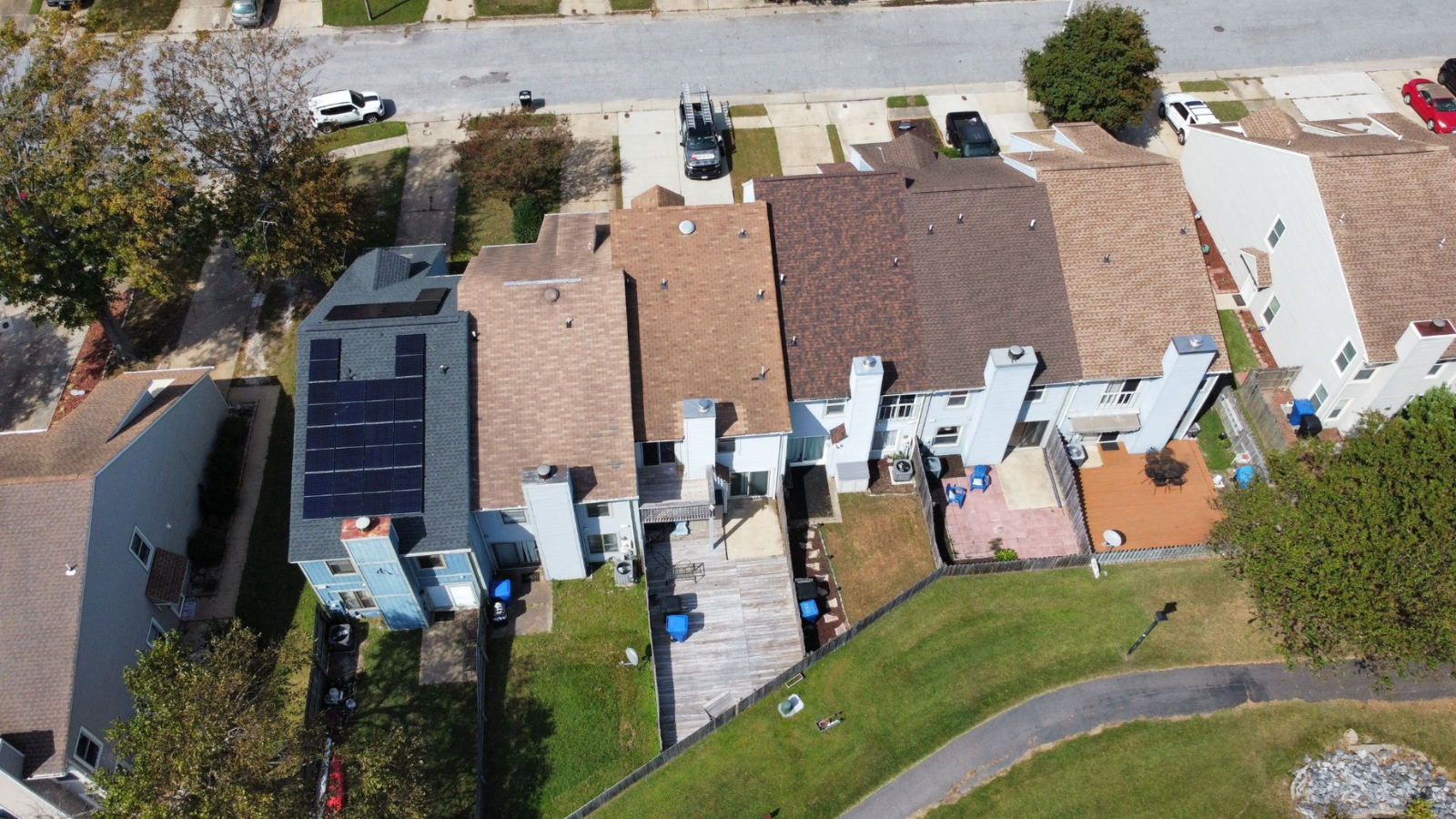
Before worrying about shingle colors or repair costs, find out who is responsible for the roof.
Do not assume that having an HOA automatically means the association replaces the roof.
Some Virginia Beach townhomes are fee-simple properties where individual owners may be responsible for their own roofing. Others may be organized as condominiums where certain exterior components are common elements. Communities can also assign particular maintenance responsibilities through declarations, bylaws, covenants, or other governing documents.
Virginia law recognizes this distinction. Under the Virginia Condominium Act, responsibility for maintenance, repair, renovation, restoration, and replacement of condominium common elements generally belongs to the unit owners’ association unless the condominium instruments provide otherwise, while individual owners are responsible for their units. That is exactly why buyers should read the governing documents instead of assuming every attached community works the same way.
For a buyer scheduling a townhome roof inspection Virginia Beach ownership documents should therefore be part of the conversation.
A contractor can tell you what appears damaged. Your association documents help tell you who may ultimately be responsible for dealing with it.
Those are two different questions, and you need answers to both.
Shared Rooflines Can Hide Problems Outside Your Unit
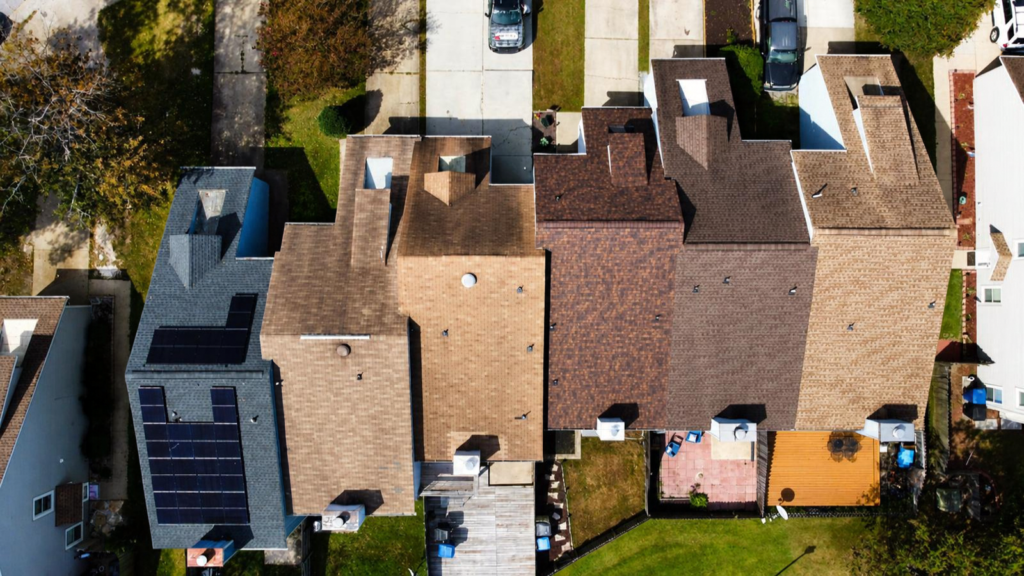
Imagine four townhomes connected under one continuous roofline.
Your section looks good.
The neighboring section has deteriorated flashing or missing shingles.
During heavy wind-driven rain, water gets beneath the roofing material and travels along decking or framing before becoming visible inside your unit.
The stain may appear over your ceiling even though the original entry point is not directly above it.
Water does not always respect property boundaries.
That is one reason a townhome roof inspection Virginia Beach property buyers consider should look beyond a narrow vertical line directly above the unit whenever access, property boundaries, and permission allow.
Roof valleys, adjoining transitions, shared drainage systems, parapets, party-wall areas, ridge lines, and changes in roofing materials can all influence how water behaves across attached structures.
The goal is not to inspect someone else’s property without permission. It is to understand whether visible conditions on the connected roof system may affect the unit you are considering purchasing.
A Patchwork Roof Deserves Questions
Townhome roofs sometimes tell their history through different shingle colors.
One unit may have newer shingles. Another may have weathered materials. A small section might have clearly been repaired, while an adjoining section looks untouched.
That does not automatically mean something is wrong.
Individual repairs may have been necessary after storm damage, tree impact, or a localized leak. The concern is whether those repairs were properly integrated into the connected roofing system.
If shingles abruptly change at a property line, ask when each section was replaced.
If one roof appears significantly newer, ask why.
If you see obvious patching near the connection between units, ask whether there was previous water intrusion.
With a townhome roof inspection Virginia Beach buyers should pay special attention to areas where old and new roofing materials meet because those transitions may involve flashing, underlayment, sealants, and other details that cannot be judged simply by comparing shingle colors.
Party Walls Add Another Layer to the Inspection
Townhomes are designed to separate adjoining residences while sharing portions of the building structure.
Depending on the property’s construction, walls between units may extend upward into attic or roof areas and incorporate fire-resistance requirements. The roofing around those transitions must still manage water correctly.
From a buyer’s perspective, you are not expected to become an expert on fire-rated assemblies or building construction.
What you should pay attention to is evidence that the roof has been altered.
Has someone installed a vent near the dividing line? Was roofing replaced on one side only? Is there visible damage or unusual patching around a transition? Does the attic show staining near the adjoining wall?
These observations can tell your inspector or roofer where to investigate further.
A detailed townhome roof inspection Virginia Beach home buyers request should consider how roof penetrations and structural transitions relate to the unit rather than treating the roof as one uninterrupted field of shingles.
Drainage Becomes Especially Important With Attached Homes
Heavy rain has to go somewhere.
On a detached house, gutters and downspouts typically serve one property. Townhome drainage can be more complicated.
A long gutter run might collect water from multiple units. A downspout may discharge near the dividing line between properties. Roof valleys can concentrate runoff from adjoining sections into the same drainage path.
If one portion becomes clogged, loose, undersized, or damaged, water may overflow onto another unit’s siding, fascia, foundation area, or lower roof.
That is why gutters should never be treated as an afterthought.
During a townhome roof inspection Virginia Beach conditions make drainage particularly worth evaluating because strong rain can expose weaknesses that may not be obvious during dry weather.
Look for stained fascia, overflowing marks on gutters, erosion near downspouts, sagging gutter sections, disconnected leaders, standing water, and staining on siding directly beneath roof edges.
Sometimes what appears to be a siding problem or foundation moisture issue actually begins with the roof drainage system.
Flashing Is Where Small Details Become Big Problems
Most roofs do not leak through the middle of a perfectly intact shingle.
Leaks are more likely to develop around transitions and penetrations.
That includes plumbing vents, exhaust vents, chimneys, skylights, valleys, roof-to-wall intersections, dormers, and locations where one section meets another.
Townhomes can contain plenty of these transitions.
A row of attached units may have several plumbing vents, exhaust penetrations, architectural changes, and wall intersections across a relatively compact roof area.
If flashing was installed incorrectly or deteriorates with age, water can enter beneath the roofing system.
For anyone arranging a townhome roof inspection Virginia Beach flashing deserves the same level of attention as the shingles themselves.
A roof can still have plenty of remaining shingle life while a deteriorated vent boot or poorly repaired flashing detail causes an active leak.
That is often good news because a localized issue may be repairable.
But you need to find it first.
The Attic May Tell You What the Exterior Cannot
If the attic space serving the townhome is accessible, it can provide valuable clues.
Roofing materials can hide a surprising amount from the outside.
Inside the attic, an inspector may notice dark staining on roof decking, water trails, damp insulation, deteriorated wood, rusty fasteners, previous repair marks, ventilation concerns, or daylight appearing where it should not.
Virginia’s home inspection standards reinforce the importance of looking at more than just visible shingles. Subject to the inspection contract and accessibility, licensed inspectors are expected to evaluate roof covering, roof ventilation, drainage systems including gutters and downspouts, readily visible flashing, roof penetrations, framing, sheathing, attic areas, and insulation.
That makes a townhome roof inspection Virginia Beach buyers obtain especially useful when exterior access is limited or the roof is too steep to safely walk.
The attic can sometimes provide the missing half of the story.
Does the Inspector Have to Walk the Townhome Roof?
Not necessarily.
A professional roof evaluation does not become useful only when someone physically walks every shingle.
Roof pitch, height, weather conditions, material condition, access restrictions, HOA rules, and safety concerns may determine how the roof is inspected.
An inspector or roofing professional may use ladders, binoculars, elevated cameras, drones where permitted, attic observations, or other methods to evaluate conditions.
What matters most is that the report explains how the roof was inspected and identifies any limitations.
If the roof could not be closely evaluated because of access, weather, HOA restrictions, or safety conditions, that is not something a buyer should simply ignore.
It may be a reason to arrange a specialized roofing assessment during the appropriate inspection or due-diligence period.
Virginia Beach Weather Changes the Conversation
Virginia Beach does not need a major hurricane for a roof to experience wear.
Repeated exposure matters too.
Coastal winds can lift vulnerable shingles. Wind-driven rain can reach flashing details that perform perfectly well during a gentle shower. Summer heat and UV exposure age roofing materials. Humidity can make moisture problems more persistent when water reaches areas that do not dry quickly.
Over years, small vulnerabilities can become bigger ones.
This does not mean every Virginia Beach townhome roof is constantly on the verge of failure.
It means local weather makes routine roof maintenance and thoughtful inspections worthwhile.
A townhome roof inspection Virginia Beach homeowners schedule after suspicious leaks, significant storms, or before purchasing can help identify conditions before they develop into a more disruptive problem.
Storm Damage May Not Stop at the Property Line
Strong wind rarely looks at a subdivision plat before damaging shingles.
A storm may affect one roof slope more than another because of wind direction, surrounding buildings, trees, elevation, and roof design.
That means your prospective townhome may look fine from the front while the rear slope has lifted shingles or impact damage.
Or the adjoining unit could have damage near a connected ridge or valley that influences the roof system around your property.
After significant weather, look for lifted or missing shingles, damaged ridge materials, loose flashing, bent gutters, displaced vents, tree debris, and newly exposed roofing surfaces.
If several neighboring units are having roofs inspected or repaired, that is another reasonable reason to ask about the history of the property you are purchasing.
Roof Age Becomes More Complicated With Townhomes
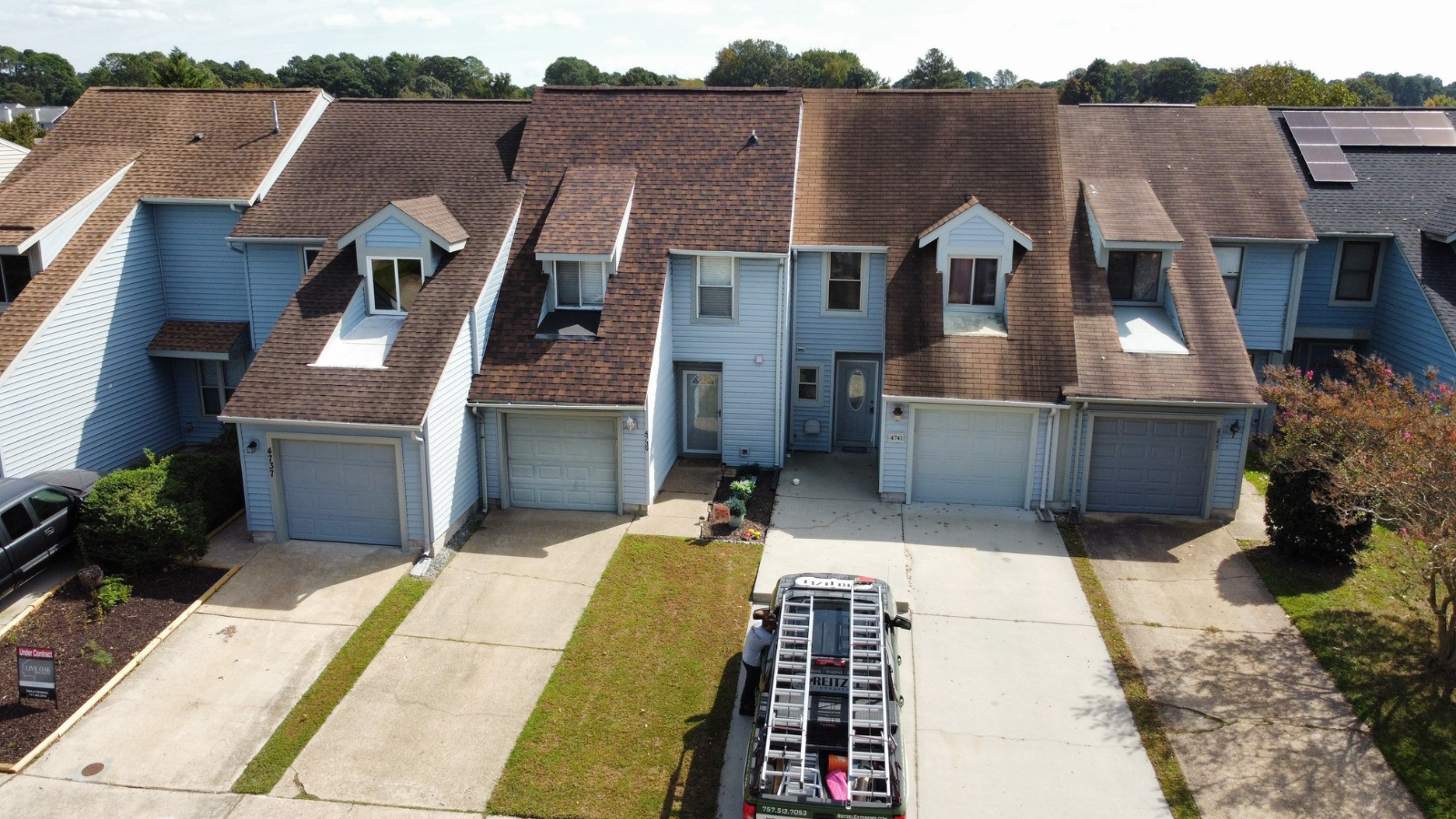
Ask a detached-home seller, “How old is the roof?” and you may receive a straightforward answer.
Ask the same question in a townhome community and the answer may be:
“This section is twelve years old.”
“The association replaced the front slope six years ago.”
“The neighboring unit had theirs done after a storm.”
“The roof is maintained by the HOA.”
“We’re not sure.”
That ambiguity is exactly why documentation matters.
When arranging a townhome roof inspection Virginia Beach buyers should pair the physical evaluation with questions about installation dates, past repairs, storm claims, warranties, association projects, and planned capital improvements.
A roof’s chronological age is useful, but condition matters just as much.
Installation quality, attic ventilation, material type, maintenance, storm exposure, repairs, and surrounding conditions all affect how a roof ages.
Townhome Roof Inspection vs. Detached Home Inspection
| Inspection Area | Detached Home | Townhome | Why Buyers Should Care |
| Roof responsibility | Usually individual homeowner | May involve owner, HOA, or condominium association | Determines who may pay for repairs |
| Connected rooflines | Usually none | Common in attached housing | Problems can originate beyond the visible unit |
| Drainage | Usually serves one property | May interact with neighboring roof sections | Shared runoff can affect multiple units |
| Roof age | Often one installation history | Different sections may have different repair histories | Makes remaining roof life harder to judge |
| Flashing transitions | Standard penetrations and walls | May include more adjoining transitions | More areas where water management matters |
| Exterior access | Controlled by homeowner | May be subject to association rules | Can affect inspection methods |
| Repair approval | Usually owner decision | HOA approval may be required | Can change repair timing and options |
| Documentation | Seller records | Seller plus association records may matter | Gives buyers a more complete history |
The table shows why a townhome roof inspection Virginia Beach buyers order should not simply copy the approach used for a detached property.
The roofing materials may be similar.
The ownership, connections, and decision-making process may not be.
Read the HOA or Condominium Documents Before Closing
This may be one of the least exciting parts of buying a townhome, but it can save a lot of confusion later.
Read the declaration, bylaws, maintenance responsibilities, architectural rules, reserve information available to you, and recent association communications.
You are looking for answers to practical questions.
Who repairs the roof?
Who replaces it?
Does the association maintain gutters?
Can an individual owner hire a roofer?
Does exterior work require approval?
Are there upcoming roofing projects?
Have there been recent assessments?
Have recurring leaks or roof concerns been discussed?
If the property is legally a condominium, Virginia law defines common elements as portions of the condominium outside the individual units, while the specific condominium instruments help determine the boundaries and responsibilities applicable to that property.
Never assume that because your neighbor’s association replaces roofs, yours will too.
Read the documents for the community you are actually buying into.
Check the Permit History When Major Roofing Work Looks Recent
If the seller says the townhome has a “new roof,” ask what that means.
Was the entire connected roof replaced?
Only the shingles above this unit?
One slope?
A storm-damaged section?
Was the work professionally completed?
The City of Virginia Beach lists roofing replacement among residential alterations requiring a building permit and lists a final inspection for roofing work.
Permit history does not tell you everything about roof quality, but it can provide useful context when significant work was reportedly completed.
For home buyers, documentation, invoices, warranties, permit information, and association records can help support what you are seeing during the physical inspection.
What If the Home Inspector Says “Roof Appears Serviceable”?
That can sound reassuring, but read the entire report.
“Serviceable” does not mean the roof is new, perfect, or guaranteed to remain leak-free for years.
Look for the details.
Did the inspector identify aging shingles?
Was there visible flashing deterioration?
Were gutters clogged?
Was access limited?
Did the attic show old staining?
Did the inspector recommend evaluation by a roofing contractor?
A townhome roof inspection Virginia Beach buyers schedule with a roofing professional can be particularly useful when the general inspection identifies concerns but cannot determine the repair scope.
The point is not to collect as many inspections as possible.
The point is to answer important questions before they become your responsibility.
Can a Roof Issue Affect Your Buying Decision?
Absolutely, but not every issue should scare you away from a good property.
A loose shingle is different from widespread roof deterioration.
A failed vent boot is different from rotten roof decking.
An old stain from a repaired leak is different from active moisture.
A roof due for replacement is also different when the association has a funded replacement project already scheduled versus when an individual owner unexpectedly has to pay the entire cost.
Context changes everything.
With a townhome roof inspection Virginia Beach buyers can move from “the roof might have a problem” to a much more useful understanding of the problem, likely repair scope, urgency, and responsibility.
That information may help you budget, ask the seller questions, review association records, discuss repairs during the transaction, or simply move forward with greater confidence.
When Repair May Make Sense and When Replacement Deserves Discussion
A few damaged shingles, one failed pipe boot, minor flashing deterioration, or a localized gutter problem may be appropriate for repair when the rest of the roof remains in good condition.
Replacement becomes more relevant when problems are widespread.
That could include extensive shingle deterioration, recurring leaks in multiple areas, widespread storm damage, aging materials across several connected units, deteriorated decking, or repeated repairs that are no longer solving the underlying issue.
Townhomes introduce another factor: coordination.
Even when a localized replacement seems technically possible, community rules, appearance requirements, shared components, and warranties may influence what work can be performed.
Before making assumptions about cost or responsibility, identify both the roofing condition and the community requirements.
Why Reitzel Roofing & Exteriors Looks Beyond the Shingles
At Reitzel Roofing & Exteriors, we know buyers do not need roofing jargon.
They need answers.
Is there an active problem?
How serious does it appear?
Does the issue look isolated?
Are there signs of previous water intrusion?
What should be addressed soon?
What can be monitored?
Are there connected roof areas that deserve further attention?
A professional townhome roof inspection Virginia Beach buyers request should help make those questions clearer, not leave you more confused than when the inspection started.
We look at the roofing system as a whole, including visible roof covering, flashing, penetrations, drainage, vents, vulnerable transitions, storm-related concerns, and accessible signs of moisture.
For attached properties, we also recognize that roof condition is only one part of the decision.
Understanding ownership and association responsibility matters too.
Don’t Let a Shared Roof Become a Shared Surprise
A townhome can be an excellent fit for a Virginia Beach buyer.
You may get the space you need, less exterior maintenance, access to community amenities, and a location that makes sense without taking on everything that comes with a detached property.
But attached living changes the roofing conversation.
The most important question is not simply, “Does this roof look okay?”
It is:
“What could this roof mean for me after closing?”
A thoughtful townhome roof inspection Virginia Beach home buyers arrange can reveal visible wear, flashing concerns, drainage problems, past moisture clues, storm damage, and areas that deserve additional investigation. Just as importantly, it can prompt you to review HOA or condominium documents so you know where maintenance responsibility actually falls.
That combination matters.
The roof may look like one continuous surface from the street, but financially and legally, it may be divided very differently underneath.
Because the best time to learn about a townhome roof problem is not during the first hard rain after you get the keys.
It is before you call the home yours.
Frequently Asked Questions About Virginia Beach Townhome Roof Inspections
1: Is a townhome roof inspection really different from a regular house roof inspection?
A: The roofing materials and basic inspection principles may be similar, but an attached home introduces questions you typically do not face with a detached property. A townhome may share rooflines, valleys, drainage routes, architectural transitions, or other exterior components with neighboring units, and responsibility for repairs may be divided between individual owners and an HOA or condominium association. That means a townhome roof inspection Virginia Beach buyer schedules should look at the physical roof while also encouraging a review of governing documents and available maintenance history. You want to know not just whether damage exists but where it appears to originate, whether connected areas could affect your unit, and who is responsible for correcting it. That extra context is what makes inspecting a townhome roof different.
2: Is the HOA automatically responsible for repairing my townhome roof?
A: No, and this is one of the most important assumptions to avoid when buying an attached home. Some associations maintain and replace roofs as common elements, while other communities make individual homeowners responsible for the roofing above their units. The answer depends on how the property is legally organized and what its declaration, bylaws, covenants, and other governing documents say. In Virginia condominiums, the association generally has responsibility for common elements unless the condominium instruments provide otherwise, but that does not mean every property marketed as a “townhome” follows the same structure. Before closing, ask for the relevant documents and identify roof, gutter, flashing, and exterior maintenance responsibilities in writing rather than relying only on what a seller or neighbor remembers.
3: Can a leak from my neighbor’s townhome roof damage the unit I am buying?
A: It is possible because water does not necessarily travel straight downward from the point where it enters. Moisture can move along roof decking, framing, insulation, flashing transitions, or adjoining construction before becoming visible inside another area. That means the ceiling stain inside the unit you are considering may not always correspond perfectly with the exterior entry point directly above it. Connected valleys, roof-to-wall intersections, gutters, drainage paths, and repairs near adjoining units deserve attention when there is a history of leakage. A qualified roofing professional can evaluate visible conditions and help determine where water is most likely entering, although concealed damage sometimes requires additional investigation. This is also why buyers should ask whether neighboring or association-maintained roof sections have had recent leaks or repairs.
4: Should I still get the roof inspected if the HOA says it maintains the roof?
A: Yes. Association responsibility can reduce your direct maintenance obligations, but it does not make roof condition irrelevant to you as a buyer. If the connected roofing system has aging materials, ongoing leaks, inadequate maintenance, or an approaching replacement project, those conditions could eventually affect your unit or the association’s finances. Review available reserve information, recent meeting records, repair history, planned projects, and any assessments or discussions involving roofing. A physical inspection can tell you what the roof appears to be doing today, while association records may tell you what the community expects to do about it tomorrow. Those two pieces of information together provide a much better picture than simply hearing “the HOA handles the roof.”
5: What should concern me most when buying a Virginia Beach townhome with an older roof?
A: Age alone should not automatically eliminate a property, but an older roof deserves a closer look at condition, repair history, water intrusion, flashing, drainage, attic evidence, storm exposure, and who will ultimately be responsible for replacement. Ask when the roof or individual sections were installed, whether leaks have occurred, whether multiple units have needed repairs, whether the association is planning a replacement, and whether funding has been set aside if the roof is a shared responsibility. Virginia Beach weather can expose vulnerable roofing details through wind and heavy rain, so a roof that has reached a later stage of its service life deserves more than a quick glance from the ground. The goal is not to find a perfectly new roof. It is to understand what you are buying and whether a major roofing expense may be approaching.