You pull into the driveway, look up, and notice something strange.
One side of your roof still looks fairly clean. The other side is noticeably darker, with black streaks, shadowy patches, or greenish buildup that seems to be getting worse every year.
Is your roof failing?
Is it mold?
Does that side need to be replaced?
Or is the difference mostly cosmetic?
Roof discoloration Virginia Beach homeowners notice can have several causes, and the darker side of the roof is not automatically the damaged side. Shade, algae, moss, debris, moisture, tree coverage, roof orientation, aging shingles, and even different repair histories can all change the way one roof slope looks compared with another.
Virginia Beach creates a good environment for these differences to become obvious. Roofs here deal with rain throughout the year, humid conditions, summer heat, trees, coastal weather, and periods when shaded surfaces may stay damp longer than sunny ones.
Some dark streaks need cleaning.
Some buildup needs professional attention.
And sometimes discoloration is only the first visible clue that one section of the roof deserves a closer inspection.
Here is how to tell the difference.
Why Can Two Sides of the Same Roof Look Completely Different?
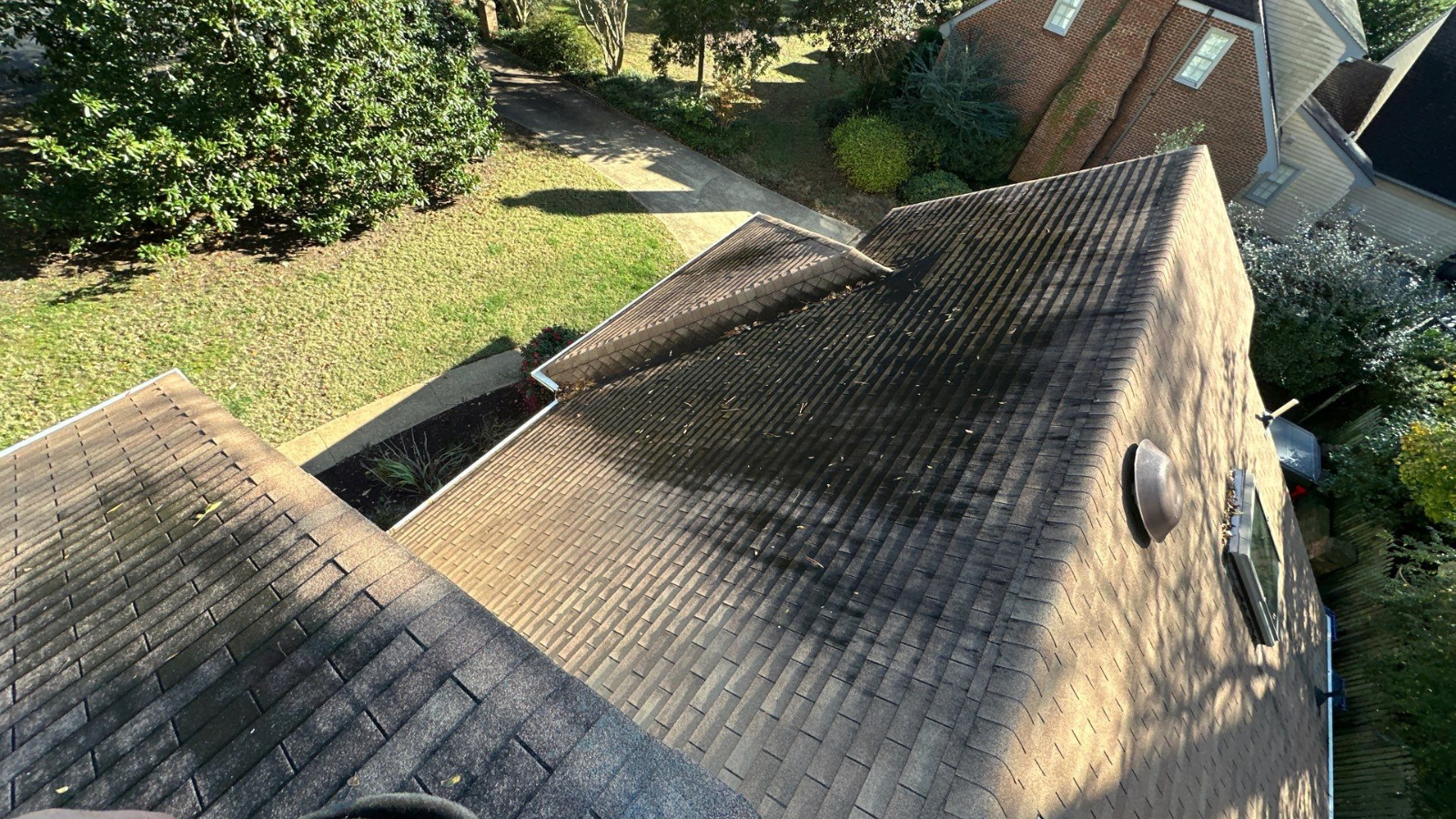
The shingles may have been installed on the same day, but that does not mean every roof slope experiences the same environment.
Think about your home throughout a normal day.
One slope may receive direct sunlight for hours.
Another may remain shaded by trees or by the orientation of the house.
One side may dry quickly after a morning rain, while the other stays damp well into the afternoon.
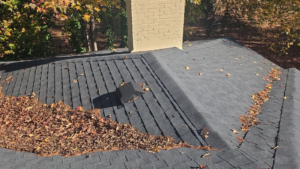
Leaves may accumulate behind a chimney or in a valley.
Branches may shade only the rear half of the roof.
Even neighboring homes can affect sunlight and airflow.
Over years, those small environmental differences can create visible roof discoloration Virginia Beach homeowners sometimes mistake for uneven shingle aging.
The darker side may simply be the side that remains damp longer.
Black Streaks Are Often Algae, Not Dirt
One of the most common explanations for dark roof streaks is algae.
The Asphalt Roofing Manufacturers Association, or ARMA, explains that brown-to-black roof discoloration is commonly associated with algae and is often mistaken for fungus, soot, dirt, moss, or tree debris. One of the most prevalent organisms associated with those dark streaks is Gloeocapsa magma.
ARMA also notes that algae discoloration is particularly common along the Eastern Seaboard and in warm, humid conditions.
That makes the issue highly relevant to Virginia Beach homeowners.
Algae spores can travel through the air and settle on roofing surfaces. Over time, dark pigmentation can create the streaked appearance many homeowners recognize.
You may notice only one slope becoming dark first because moisture and sun exposure vary across the roof.
According to ARMA, algae discoloration itself is generally considered an appearance issue on asphalt shingles rather than proof that the shingles are structurally failing.
That is an important distinction.
A dark roof does not automatically mean you need a new roof.
Why the North-Facing Side Often Looks Darker
If one side of your home receives noticeably less sun, pay attention to that roof slope.
ARMA notes that moss tends to grow on north-facing roof planes because they receive less direct sunlight and can remain damp longer than sunnier slopes. Overhanging trees add even more shade and can drop organic debris that helps hold moisture against the roof surface.
That does not mean every north-facing Virginia Beach roof will develop moss or algae.
It means the conditions are often more favorable.
This is one of the biggest reasons roof discoloration Virginia Beach homeowners notice may appear dramatically worse on one elevation while the opposite side looks almost new.
The shingles are experiencing two different drying patterns.
Virginia Beach Gets Plenty of Rain to Keep Roofs Wet
Local weather helps explain why moisture management matters.
National Weather Service climate records for the nearby Norfolk area show rainfall throughout the year, with substantial precipitation during the warmer summer months as well.
That does not mean rainfall itself damages a properly functioning roof.
Roofs are obviously designed to handle rain.
The concern is what happens when shade, debris, poor drainage, or vegetation causes one area to remain wet longer than the rest.
A roof that dries quickly after a storm creates a different environment than a shaded slope where leaves and moisture linger.
For homeowners investigating roof discoloration Virginia Beach climate conditions should therefore be considered alongside the condition of the shingles themselves.
Algae and Moss Are Not the Same Problem
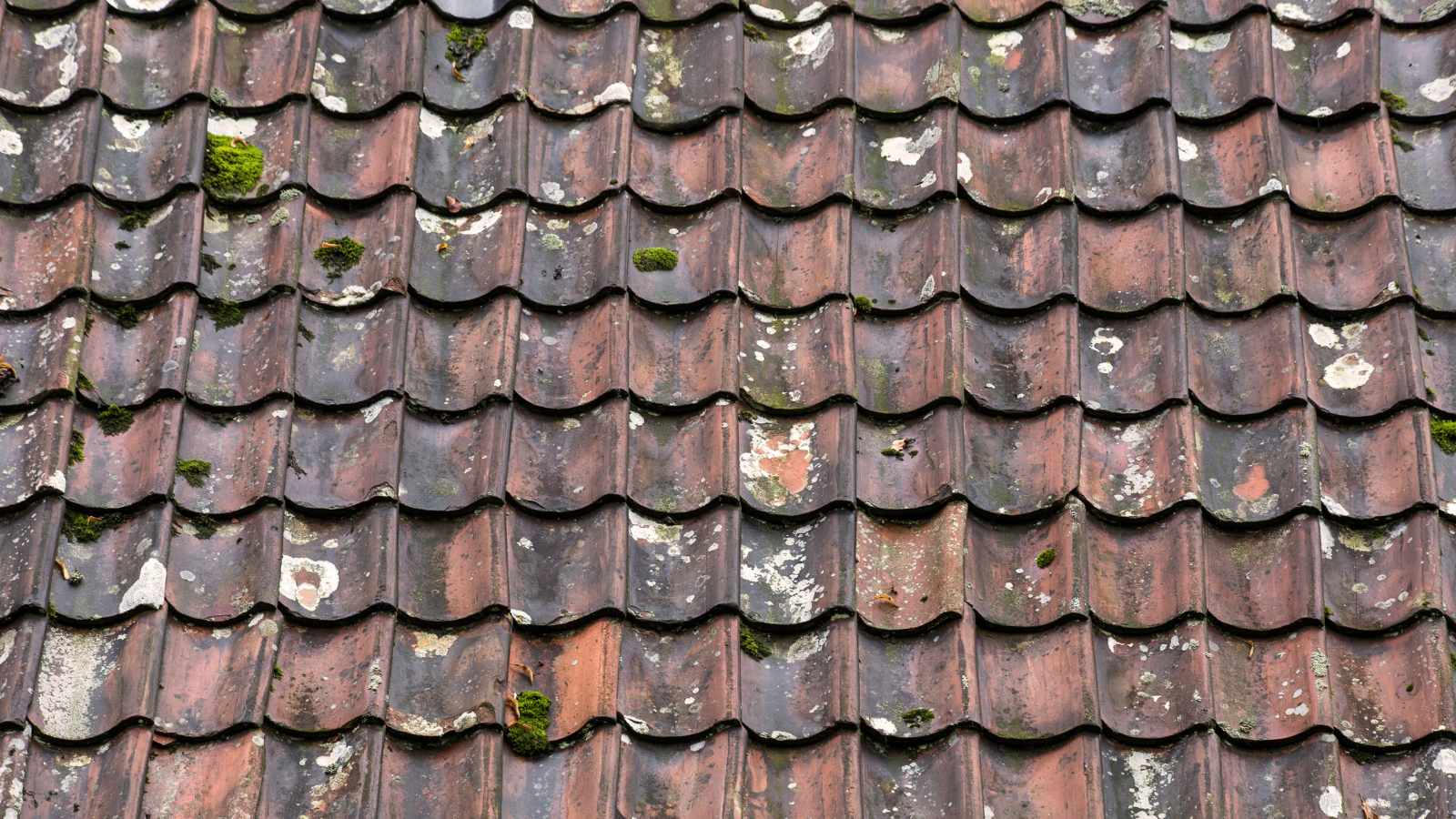
This distinction matters.
Dark algae streaks and moss growth can appear on the same roof, but they should not be treated as identical.
Algae often appears as black or brown streaking or broader discoloration.
Moss is a plant that creates visible raised growth.
According to ARMA, algae is primarily an aesthetic concern for asphalt shingles, while moss can become more problematic because accumulated moss may lift or curl shingle edges and increase vulnerability to wind or lateral water movement.
That means a dark streak and a thick green patch deserve different levels of concern.
If the roof is simply discolored, professional cleaning may be appropriate depending on the roofing manufacturer’s recommendations.
If moss has become thick enough to affect shingle edges, the roof itself deserves closer evaluation.
Trees Can Create the Perfect Conditions for One Dark Roof Slope
Trees provide shade, privacy, and curb appeal.
They can also change the microclimate around your roof.
Branches extending above the house can reduce direct sunlight and airflow. Leaves, pine needles, seed pods, twigs, and other debris can collect on shingles and in valleys.
That debris can hold moisture against the roofing surface.
ARMA recommends trimming back branches where appropriate to increase sunlight and reduce debris accumulation as part of preventing moss and algae growth.
For roof discoloration Virginia Beach properties surrounded by mature trees may develop a noticeably different appearance than homes in open neighborhoods with full sun.
You do not necessarily need to remove healthy trees.
But keeping branches from directly crowding the roof and preventing heavy debris accumulation can make routine roof maintenance easier.
Debris Can Make One Section Look Older Than It Really Is
A pile of leaves can create a dark patch that looks alarming from the ground.
If debris sits there long enough, the area may also retain moisture and encourage organic growth.
Roof valleys are especially vulnerable because they naturally collect runoff and may trap leaves.
Areas behind chimneys and dormers can collect debris too.
This is one reason homeowners should not diagnose a dark roof based on color alone.
A professional inspection may reveal that the “bad” section simply needs debris removed and the underlying shingles are still serviceable.
Or it may reveal that the buildup has been sitting there long enough to affect roofing materials beneath it.
The difference matters.
Is the Discoloration Actually Granule Loss?
Not every color change comes from something growing on the roof.
Asphalt shingles are surfaced with mineral granules.
Those granules contribute to the appearance of the roof and protect the asphalt layer underneath.
If one area has lost significantly more granules than another, it may appear lighter, darker, smoother, or simply different in texture depending on the roofing product and lighting conditions.
Granule loss can occur from aging, storm impact, foot traffic, mechanical damage, manufacturing characteristics, or other causes.
A professional should look at texture as well as color.
If roof discoloration Virginia Beach homeowners notice is accompanied by bald-looking patches, exposed substrate, excessive loose granules in gutters, cracking, or damaged shingles, the concern may extend beyond ordinary algae staining.
Newer Repairs Can Make the Old Roof Look Darker
Sometimes the darker side is not actually darker.
The other side may simply be newer.
Imagine one roof slope was repaired after storm damage five years ago while the rest of the roof is fifteen years old.
New shingles may have a richer color, sharper granule pattern, and less weathering than the original material.
From the street, the contrast can make the older section look unusually faded or dark.
The same thing can happen after localized shingle repair.
Even replacement shingles from the same manufacturer and color line may not match weathered roofing perfectly.
Before assuming there is biological growth or widespread deterioration, consider the repair history of the roof.
Roof Discoloration Causes at a Glance
| What You See | Possible Cause | What It May Mean | Best Next Step |
| Black streaks | Algae | Often primarily cosmetic | Professional evaluation and manufacturer-approved cleaning |
| Green raised patches | Moss | May affect shingle edges if growth becomes heavy | Have condition evaluated |
| Dark area beneath trees | Shade, debris, moisture | Roof may stay damp longer | Clear debris and inspect shingles |
| One darker north-facing slope | Reduced sunlight | Favorable conditions for algae or moss | Monitor and inspect |
| Dark valley | Debris or water concentration | Moisture may remain longer | Check drainage and roofing condition |
| Uneven color after repair | New vs. weathered shingles | Often cosmetic mismatch | Review repair history |
| Smooth or bald-looking spots | Granule loss | Could indicate aging or damage | Roofing inspection recommended |
| Dark stain near chimney | Moisture, debris, flashing issue | May require more than cleaning | Inspect flashing and roof transition |
| Green growth near gutters | Persistent moisture | Drainage may contribute | Check gutters and roof edge |
| Sudden discoloration after storm | Debris, shingle damage, moisture | Possible storm-related condition | Have roof professionally inspected |
The important point is that roof discoloration Virginia Beach homes develop is a symptom, not a diagnosis.
Color tells you where to look.
It does not always tell you what is wrong.
Could Gutters Be Contributing to the Problem?
Yes.
Gutters are supposed to collect water leaving the roof and move it away through downspouts.
When they clog, overflow, or drain poorly, moisture patterns around the roof edge can change.
ARMA recommends keeping gutters clean so water can drain properly and advises against allowing upper-roof gutters to discharge directly onto lower roof areas.
If the darkest part of your roof appears near one gutter line or below an upper downspout, investigate the drainage pattern.
Sometimes homeowners spend money cleaning shingles when the more important maintenance issue is controlling where water travels.
Check the Attic if the Dark Area Looks Suspicious
Exterior discoloration is usually visible long before you know whether there is a moisture problem underneath.
If the roof surface has an unusual dark section and there are other warning signs, the attic may provide more information.
Look for staining on roof decking, damp insulation, rusty fasteners, water trails, or signs of previous leakage when the attic is safely accessible.
A dark roof does not mean water has entered the attic.
But if roof discoloration Virginia Beach homeowners see is accompanied by interior staining or musty conditions, a closer inspection becomes much more important.
The objective is to separate an exterior appearance issue from actual moisture intrusion.
Does Darker Roofing Mean That Side Is Hotter?
Not necessarily.
A roof may look darker because of algae, staining, shade, aging materials, lighting, or a different batch of shingles.
You cannot reliably determine roof temperature or attic performance simply by looking at the color difference from the driveway.
Sun exposure often matters more in the moment.
A darker-looking north-facing roof may actually receive much less direct solar exposure than a cleaner-looking southern slope.
If attic heat or energy efficiency is your concern, evaluate ventilation, insulation, roofing materials, air sealing, and actual conditions rather than using discoloration as a temperature test.
Should You Pressure Wash Dark Roof Shingles?
For asphalt shingles, this is where homeowners need to be careful.
ARMA specifically advises against using pressure washers to remove algae from asphalt roofing because high-pressure cleaning can damage the roofing surface and contribute to granule loss.
That means the most aggressive-looking cleaning method is not necessarily the smartest one.
The manufacturer of your specific shingles should be the first reference for approved cleaning procedures.
Professional roof cleaners or roofing contractors should use methods compatible with the roofing product.
For roof discoloration Virginia Beach homeowners want removed, the objective should be improving appearance without shortening the life of the material underneath.
Be Careful With DIY Roof-Cleaning Solutions
A quick online search can produce dozens of homemade roof-cleaning formulas.
That does not mean everyone belongs on your shingles.
ARMA advises homeowners to consult the roofing manufacturer about recommended cleaning procedures and warns that cleaning solutions can make the roof extremely slippery.
There is also landscaping to consider.
Roof runoff can reach shrubs, grass, siding, gutters, decks, and other surfaces below.
And climbing onto a damp roof introduces a significant fall hazard.
If the staining is substantial or the roof is steep, professional evaluation is usually the safer path.
Roof Cleaning Virginia Beach: Can It Make the Roof Look New Again?
Sometimes the improvement can be dramatic.
But cleaning cannot reverse material aging.
If the shingles are faded, granules have worn away, edges are curling, or roofing materials are deteriorated, removing algae will not restore them to new condition.
This distinction matters because homeowners sometimes confuse “dirty roof” with “old roof.”
They can overlap.
A ten-year-old roof may have severe algae staining but plenty of remaining service life.
A twenty-five-year-old roof may be dark because of staining while also showing genuine age-related deterioration.
Both conditions need to be evaluated separately.
When Discoloration Is Mostly Cosmetic
Dark streaking is less concerning when the shingles otherwise lie flat, the granule surface appears intact, there are no active leaks, moss is not lifting shingle edges, and the roofing system is performing properly.
In those situations, the conversation may focus mainly on cleaning, maintenance, tree management, and improving curb appeal.
ARMA notes that algae discoloration on asphalt shingles is generally an aesthetic concern rather than proof that the shingle has been damaged.
That can be reassuring to homeowners who see black streaks and immediately assume they need a new roof.
Do not replace a roof simply because it looks dirty without understanding what you are seeing.
When a Darker Roof Section Deserves an Inspection
Pay more attention when discoloration is accompanied by physical changes.
That can include lifted shingles, curling edges, thick moss, missing shingles, visible granule loss, deteriorated flashing, soft decking, sagging, recurring leaks, or staining inside the attic.
Sudden changes after a storm also deserve attention.
If one section that previously looked normal suddenly appears damaged or uneven, weather may have affected the shingles or deposited debris.
For roof discoloration Virginia Beach homeowners notice alongside those symptoms, an inspection is more useful than simply scheduling a cleaning.
Cleaning treats appearance.
Inspection helps determine conditions.
Why You Should Look at Every Roof Slope
The darkest slope naturally attracts your attention.
Do not ignore the clean-looking side.
A brighter roof section could still have damaged flashing, lifted shingles, storm damage, aging sealants, or other concerns unrelated to discoloration.
Likewise, the darkest slope may turn out to be structurally sound and simply affected by algae.
A complete roof inspection should evaluate all practical slopes, valleys, roof-to-wall intersections, penetrations, flashing, edges, and drainage areas rather than focusing only on color.
At Reitzel Roofing & Exteriors, that bigger-picture approach matters.
We want to know how the roof is performing, not just whether every shingle is the same shade.
What About Algae-Resistant Shingles?
If your current roof is approaching replacement age and algae has been a recurring problem, ask about algae-resistant roofing products.
ARMA notes that manufacturers offer shingles designed with algae-resistant technology, including products incorporating copper-containing granules that help inhibit algae growth.
That does not mean algae resistance guarantees a permanently spotless roof.
Product warranties, technologies, and resistance periods vary.
But if your Virginia Beach property is shaded or has a long history of black streaking, algae resistance can be worth discussing when it is time for replacement.
Why Reitzel Roofing & Exteriors Looks Beyond the Stain
At Reitzel Roofing & Exteriors, we know the dark side of your roof can be frustrating.
It can make a well-maintained home look older than it really is.
But we also know appearances can be misleading.
For roof discoloration Virginia Beach homeowners ask us about, the goal should be identifying the cause before deciding on the solution.
Is it algae?
Is moss beginning to lift the shingles?
Are trees creating excessive shade and debris?
Is a valley staying wet because of buildup?
Does the roof simply have shingles of different ages?
Or are there signs that the roofing material itself is deteriorating?
Those questions matter much more than immediately deciding the roof needs cleaning or replacement.
A Darker Roof Is Telling You Something—But Not Always What You Think
When one side of your roof turns black, brown, or green while the other side stays clean, it is easy to assume the darker side is failing.
Sometimes it is simply experiencing a different environment.
Less sunlight.
More shade.
More tree debris.
Longer drying times.
More algae.
And sometimes the discoloration really is sitting beside a roofing problem that deserves attention.
That is why roof discoloration Virginia Beach homeowners notice should be investigated before it is either ignored or treated too aggressively.
Do not assume every black streak means replacement.
Do not assume every dark section only needs cleaning either.
Look at the complete roof.
Consider the shade.
Check the trees and drainage.
Pay attention to moss, damaged shingles, granule loss, leaks, and physical changes in the roofing surface.
Because when your roof changes color, the smartest first step is not guessing what caused it.
It is finding out.
FAQs
1: Why is only one side of my Virginia Beach roof covered in black streaks?
A: The most likely explanation is that the affected roof slope creates better conditions for algae growth than the cleaner side. Differences in sunlight, shade, tree coverage, airflow, and drying time can cause one section to remain damp longer after rain. ARMA notes that algae discoloration is especially common in warm, humid regions and along the Eastern Seaboard, while moss commonly develops on north-facing roof planes that receive less direct sunlight. If the shingles are otherwise intact and the staining resembles dark streaks rather than thick raised growth, the problem may be primarily cosmetic. A professional evaluation can help distinguish ordinary algae from moss, shingle deterioration, or another roofing issue.
2: Does roof discoloration mean my shingles need to be replaced?
A: Not automatically. Roof discoloration Virginia Beach homeowners notice is often caused by algae, environmental staining, shade, debris, or differences in shingle age rather than roofing failure. ARMA states that algae discoloration on asphalt roofing is generally an aesthetic issue. Replacement becomes more relevant when discoloration appears alongside physical deterioration such as widespread granule loss, curling shingles, cracking, exposed material, repeated leaks, damaged flashing, or roof decking concerns. Before replacing an otherwise serviceable roof because of dark streaks, have the condition properly identified. You may be looking at a maintenance issue rather than a replacement issue.
3: Can moss damage my asphalt shingle roof?
A: Moss deserves more concern than ordinary algae staining because heavy growth can interact physically with shingles. ARMA explains that moss can grow beneath shingle edges, potentially causing them to lift or curl and increasing vulnerability to wind. Heavy buildup can also interfere with normal water movement. If you notice thick green growth rather than flat black streaking, do not pull or scrape aggressively at the shingles yourself. Removing established moss incorrectly can damage the roofing surface. Have the area evaluated and follow the roofing manufacturer’s recommended maintenance or cleaning approach.
4: Can I pressure wash the dark side of my roof?
A: Pressure washing asphalt shingles is generally not recommended. ARMA specifically warns against high-pressure washing because it can remove protective granules and damage asphalt roofing. Homeowners sometimes assume stronger pressure will produce better cleaning results, but roofing is not the same as a concrete driveway. The correct cleaning method depends on the roofing product and manufacturer’s recommendations. Roof-cleaning solutions can also make the surface extremely slippery, creating an additional safety hazard. If roof discoloration Virginia Beach conditions have made extensive, professional cleaning or roofing guidance is usually safer than experimenting with high-pressure equipment.
5: How can I keep one side of my roof from turning dark again?
A: You may not be able to prevent every future stain, but you can reduce some of the conditions that encourage algae, moss, and moisture retention. Keep gutters flowing properly, remove accumulated roof debris using methods appropriate for the roofing product, and consider trimming overhanging branches where appropriate so the roof receives more sunlight and airflow. ARMA specifically recommends reducing tree shade and debris accumulation as part of moss and algae prevention. If discoloration repeatedly returns, ask about manufacturer-approved cleaning and, when the roof eventually needs replacement, whether an algae-resistant shingle would make sense for your property.