Fresh deck boards can make an old backyard feel brand-new overnight.
The wood is clean. The railings look sharp. The stairs feel solid under your feet. Add a table, a grill, and a few chairs, and it is easy to assume the entire deck is ready for another decade of summer evenings.
But what is underneath those new boards?
That is the question homeowners sometimes forget to ask.
A deck can look beautiful on top while the ledger, joists, beams, posts, connections, or footings underneath are showing their age. And when it comes to deck framing Virginia Beach homeowners depend on, those hidden components are the part of the structure actually carrying people, furniture, grills, planters, and everything else you place on the deck.
Virginia Beach weather makes that structure even more important. Rain, humidity, changing temperatures, and years of outdoor exposure can gradually affect wood and metal connections. Areas close to the coast may also face additional exposure that makes corrosion-resistant hardware and routine maintenance worth paying attention to.
Because a beautiful deck is only truly improved when you can feel confident about what is holding it up.
Your Deck Boards Are Only the Surface
When most homeowners say their deck is getting old, they are usually talking about what they can see.
Boards fade.
Stain wears away.
Wood develops cracks.
Fasteners become visible.
Railings start looking dated.
Those signs matter, but the deck boards are only the finished surface of a much larger structural system.
Underneath them are joists that support the decking, beams that carry those joists, posts that transfer loads toward the ground, footings that support the structure, and connections that tie everything together.
If the deck is attached to your house, the ledger connection may also play a major structural role.
That is why evaluating deck framing Virginia Beach homes already have should happen before simply covering the old structure with attractive new decking.
Replacing worn boards does not automatically renew everything underneath them.
One of the Best Times to Inspect Framing Is When Old Decking Comes Off
Removing old deck boards creates an opportunity homeowners rarely get.
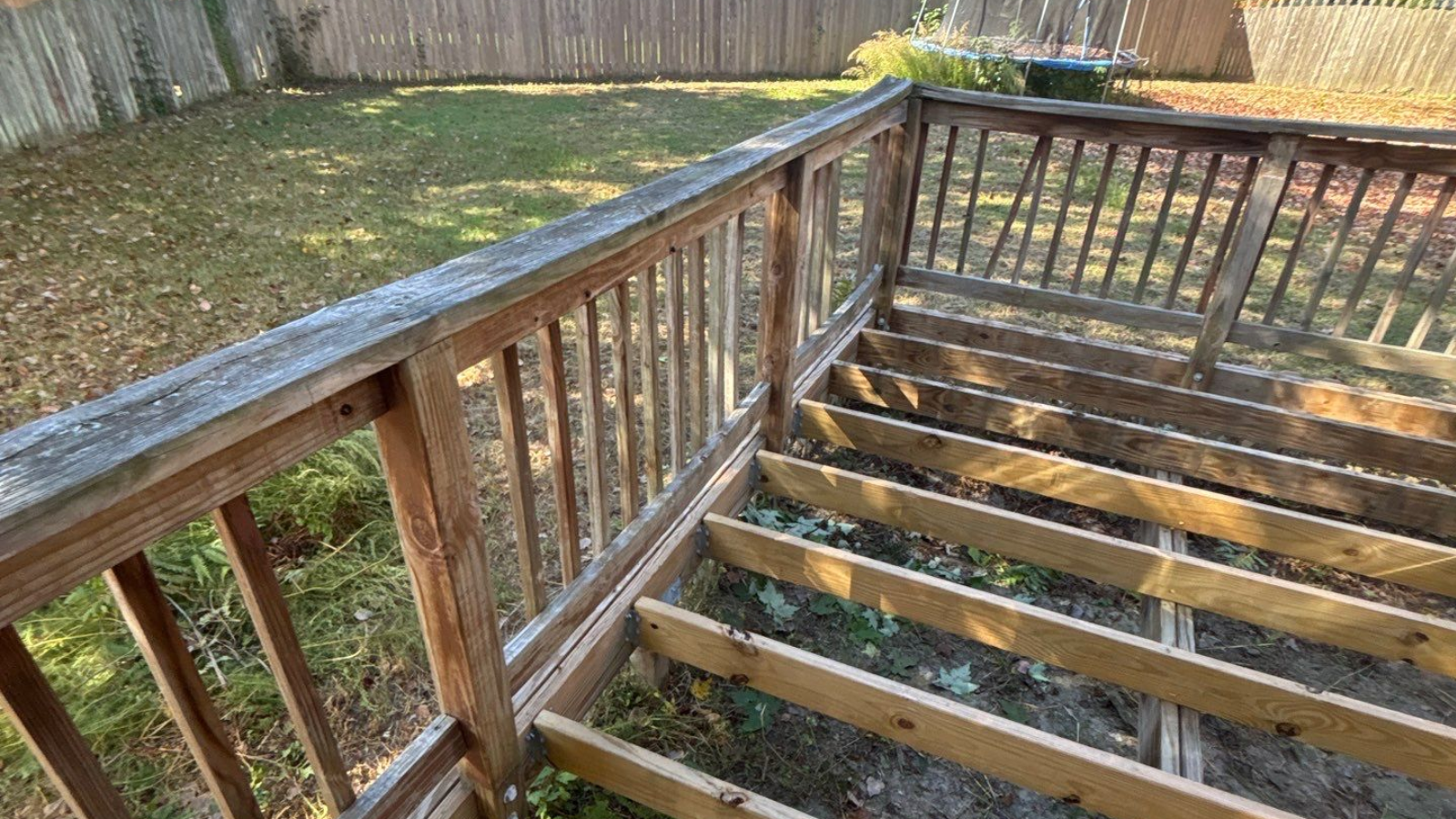
Suddenly, the framing is exposed.
Instead of trying to inspect joists through narrow gaps, contractors can see much more of their upper surfaces, connections, blocking, fasteners, and general condition.
This is exactly when hidden deterioration may become obvious.
A joist can look relatively normal from below while the top edge beneath the decking has experienced repeated moisture exposure. Old fastener holes can weaken areas. Wood may show splitting, decay, checking, or previous repair attempts that were hidden under the finished surface.
If you are already investing in a deck renovation, this is the time to ask what the framing looks like.
The Ledger Connection Deserves Serious Attention
For many attached decks, the ledger is one of the most important pieces of framing.
The ledger is the board connected to the home that helps support the deck joists.
If that connection is inadequate, deteriorated, improperly fastened, or affected by moisture, the concern can become much more significant than one cracked deck board.
The City of Virginia Beach specifically highlights proper attachment during deck inspections and notes that the ledger connection between a deck and the main structure deserves close attention. Its deck-safety guidance also tells property owners to have professionals check fasteners, supports, wood deterioration, and flashing.
That makes the ledger an essential part of a deck framing Virginia Beach evaluation.
You are looking for more than whether the board appears to be attached.
The connection should be appropriate for the structure, fasteners should remain secure and suitable for the application, and water should be managed so the area does not remain unnecessarily wet.
Flashing Helps Protect the Deck and the House
Where an attached deck meets the home, water management matters.
Rainwater can move between deck boards and reach areas around the ledger. Without proper flashing and drainage, moisture may affect not only the deck structure but also the building materials behind it.
This is one reason homeowners should avoid thinking about decks as completely separate from their homes.
The City of Virginia Beach specifically includes flashing among the items a licensed professional should evaluate, explaining that it should remain in good repair and protect the ledger board and main structure from water intrusion.
When assessing deck framing Virginia Beach homeowners should therefore look at the connection to the house as a system.
If the deck has been pulling away from the siding, staining is visible around the connection, or wood near the house feels soft, those are reasons to investigate rather than simply install new deck boards over everything.
Joists Carry More Than You Think
Every time someone walks across your deck, the decking transfers that load to the joists below.
Add furniture, a grill, several guests, large planters, and normal movement, and those framing members have a serious job.
Joists should be evaluated for deterioration, excessive splitting, sagging, unusual movement, damaged connections, and signs of previous modifications.
Older decks sometimes reveal questionable repairs.
A damaged joist may have been reinforced years ago. New holes may have been drilled for utilities. Sections may have been cut or altered. A newer board may sit beside much older framing.
Not every repair is a problem.
But homeowners should know what was changed and whether the remaining framing is still appropriate for the deck.
Virginia’s current Residential Code establishes structural requirements for decks and lists a minimum uniformly distributed live load of 40 pounds per square foot for exterior decks.
That is an important reminder that deck framing is structural construction—not just support for decorative boards.
Beams Carry the Joists
Follow the joists farther out and they typically transfer their loads to one or more beams.
Those beams then transfer loads into supporting posts and ultimately the foundations or footings below.
A beam that is sagging, separating, significantly cracked, or poorly connected deserves attention.
Again, age alone does not automatically mean the beam is unsafe.
Wood naturally develops some checks and visual changes as it dries and weathers.
The question is whether those changes affect structural performance.
This is where experience matters.
Homeowners should not have to decide from a YouTube video whether a structural crack is harmless or serious.
When there is uncertainty, have the framing evaluated by someone qualified to assess the deck.
Posts Need More Than a Quick Look
Deck posts may appear simple, but they are part of the load path carrying the structure toward the ground.
Check whether posts remain reasonably plumb and stable.
Look for visible deterioration near their lower ends, especially where wood remains close to moisture.
Pay attention to connections between posts and beams as well as the base connection.
If a post looks twisted, heavily split, displaced, or deteriorated, replacing surface decking around it does not address the structural concern.
A complete deck framing Virginia Beach renovation should evaluate these supports while access is available.
The Footings Are Where the Deck Meets the Ground
You can install premium decking and beautiful railings, but the structure still depends on what supports it below.
Virginia’s current residential-code guidance requires deck loads to be transferred to suitable foundations or approved structural support systems. Current Virginia deck provisions also address footing requirements for decks.
Footing concerns can show up as uneven settlement, movement, leaning posts, or portions of the deck that no longer feel level.
Soil conditions, drainage, age, construction methods, and previous alterations can all influence what you find.
This is another reason a deck inspection should start at the ground and work upward rather than focusing only on the surface.
Fasteners Are Small Components With a Big Job
A deck can contain a surprising number of nails, screws, bolts, hangers, and other connectors.
Those pieces tie the structure together.
Outdoor conditions can be demanding on metal, particularly where moisture repeatedly reaches connections.
The City of Virginia Beach recommends that professional deck inspections check whether approved fasteners were used and whether they remain tight and free from corrosion.
Rust staining, loose hardware, missing fasteners, damaged hangers, or connections that appear to have been improvised deserve attention.
For deck framing Virginia Beach projects, compatible corrosion-resistant hardware is particularly important because structural lumber and fasteners are expected to spend their lives outdoors.
The strongest-looking joist in the world is not very useful if its connection fails.
Guardrails Should Be Connected to Framing, Not Just Decking
Railings are often treated as decorative.
Structurally, they are much more important.
People lean against them.
Children grab them.
Guests may place their weight against them without thinking twice.
Virginia’s current deck provisions specifically address guard connections and require guard loads to transfer into the deck framing. The code includes methods for guards supported from the side or top of deck framing.
That is why a railing that feels loose should never be dismissed as merely annoying.
Movement can indicate that connections or supporting framing deserve closer inspection.
When renovating an older deck, railings should be evaluated as part of the structure rather than simply replaced with a prettier style.
Stairs Deserve Their Own Inspection
Deck stairs experience repetitive movement every time someone enters or leaves the deck.
Check the stringers, treads, connections, railings, landings, and the area where the staircase attaches to the deck.
Outdoor stair framing can deteriorate differently from the main platform because it is more exposed on multiple sides.
A stair may also have been repaired several times during the life of the deck.
Loose treads and shaky railings get attention quickly because homeowners feel them.
What is less obvious is whether the framing supporting those components is still solid.
That is why deck framing Virginia Beach inspections should include stairs instead of stopping at the main deck platform.
What Strong Deck Framing Should Accomplish
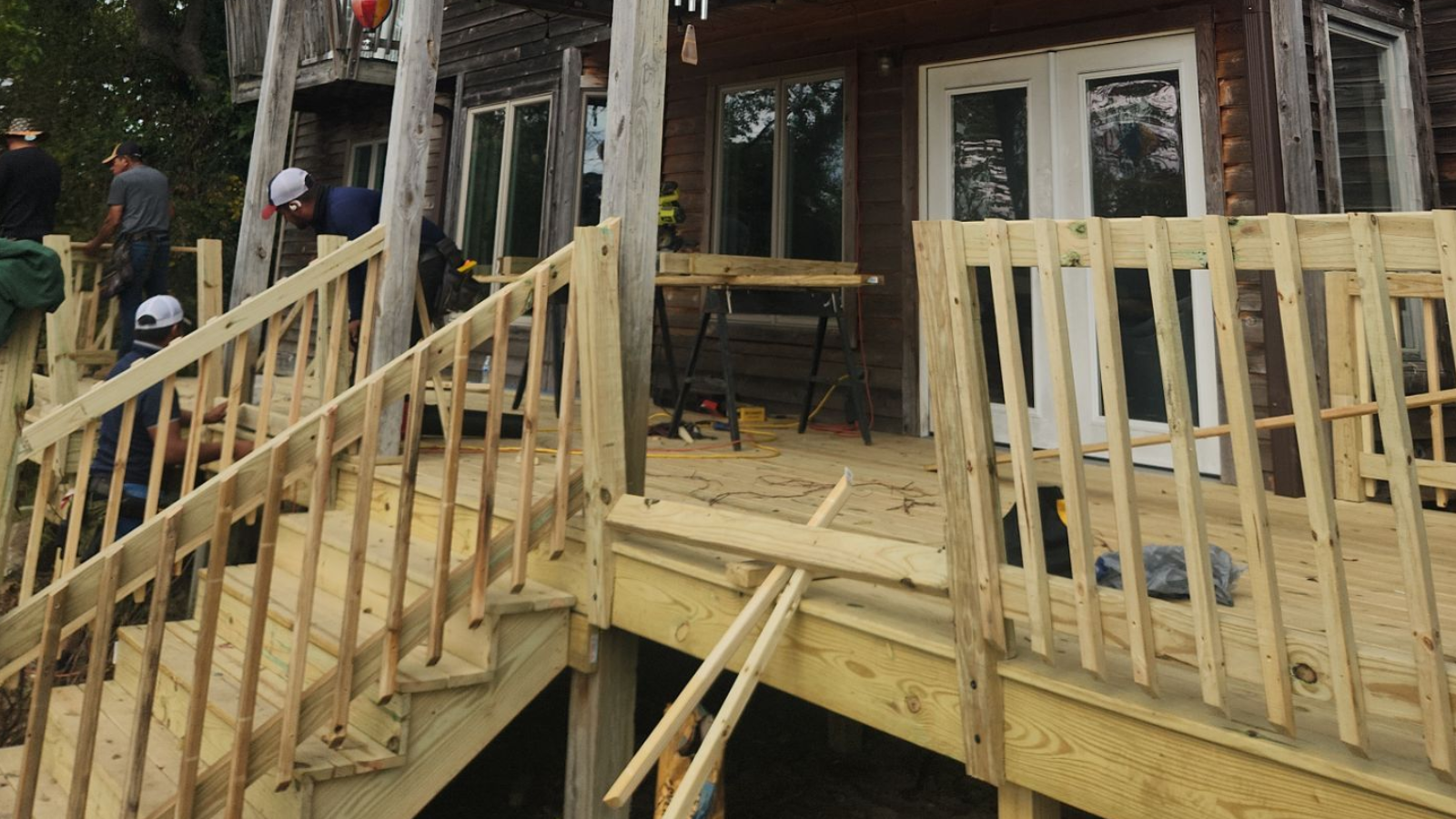
The purpose of good framing is not to look impressive when the boards are removed.
It is to create a continuous, dependable load path.
The deck surface transfers loads into joists.
Joists transfer them toward beams or the house connection.
Beams transfer loads into posts.
Posts transfer them toward footings.
Guards and stairs need their own secure connections.
And water management helps protect the materials that make that structural path possible.
Virginia’s Residential Code specifically requires exterior decks and similar facilities to be positively anchored to the primary structure to resist vertical and lateral forces or be designed to be self-supporting.
That is the bigger picture behind deck framing Virginia Beach construction.
Every component should have a reason for being there.
Old Decking Can Hide a Bigger Project Than Expected
Homeowners sometimes begin with a simple idea:
“Let’s replace the boards.”
Then the old decking comes off.
A few joists are deteriorated.
The stairs need work.
Railings no longer meet the desired standard.
There is moisture damage around the house connection.
Suddenly, a cosmetic resurfacing project becomes a framing project.
That can be frustrating, but discovering structural concerns while everything is exposed is much better than hiding them beneath expensive new decking.
A contractor should explain the possibility before demolition.
Your estimate should also explain how unexpected framing repairs are handled so you understand how additional work will be documented and approved.
Resurfacing vs. Rebuilding: Know the Difference
| Deck condition | Resurfacing may make sense | Framing repair or rebuilding may make more sense |
| Deck boards worn but framing solid | Yes | Usually unnecessary |
| Surface fading and cosmetic wear | Yes | Not unless structural concerns exist |
| One isolated framing repair | Possibly | Repair affected member before resurfacing |
| Multiple deteriorated joists | Less attractive | Structural work deserves priority |
| Loose or deteriorated ledger connection | No surface-only solution | Connection must be evaluated |
| Significant post deterioration | No | Structural support requires attention |
| Widespread corroded connectors | Not until corrected | Hardware and connections need evaluation |
| Major stair deterioration | Decking alone will not solve it | Stair structure may require rebuilding |
| Extensive movement or sagging | No | Determine structural cause first |
| Multiple structural issues | Often poor value to resurface only | Larger rebuild may offer better long-term value |
A beautiful surface cannot compensate for compromised framing.
When deciding whether deck framing Virginia Beach homes can be reused, condition should come before the desire to save the existing structure at all costs.
Virginia Beach Requires Deck Permits
Deck work is structural construction, and local permit requirements reflect that.
According to the City of Virginia Beach, permits and inspections are required for construction of a new deck regardless of its size or height. The city also states that a permit is required for structural alterations or structural repairs and that an approved final inspection is required before a new or structurally altered deck is used.
This is particularly important when a planned resurfacing project becomes a structural rebuild.
Changing decking boards is one thing.
Replacing joists, beams, posts, structural connections, or other major framing can change the scope substantially.
Homeowners should discuss permitting with their contractor before structural work begins rather than trying to determine requirements after the deck has already been rebuilt.
Virginia Beach Recommends Routine Professional Inspections
Here is one of the strongest local reasons not to ignore the framing.
The City of Virginia Beach recommends that property owners or managers have decks, balconies, and porches inspected annually by a licensed professional, such as a certified home inspector, deck builder, general contractor, or engineer. The city points to age, lack of maintenance, improper installation, and excessive loads as potential contributors to deck failures.
That advice is particularly valuable for older decks whose construction history is uncertain.
Maybe you purchased the house with the deck already there.
Maybe previous owners made repairs.
Maybe you do not know when the joists were last closely inspected.
The surface cannot answer those questions.
A closer structural look can.
Warning Signs Homeowners Should Not Ignore
Not every weathered deck needs to be demolished.
Outdoor wood naturally changes color, develops surface checks, and shows age.
What matters is identifying signs that may indicate something beyond normal appearance.
A deck that moves excessively underfoot deserves attention.
So does noticeable sagging, loose railing posts, stairs pulling away, deteriorated wood around connections, significant corrosion, or repeated moisture damage near the home.
If something suddenly feels different, investigate.
Do not simply tighten one visible screw and assume the entire issue has been solved.
Water Is One of Framing’s Biggest Long-Term Enemies
Wood decks are built outdoors, so getting wet is unavoidable.
The bigger concern is water repeatedly becoming trapped in vulnerable areas.
Leaves and debris can hold moisture along joists.
Poor flashing can allow water to affect the ledger or house connection.
Drainage problems around footings can keep lower areas wetter.
Old coatings may no longer protect exposed wood surfaces as well as they once did.
For deck framing Virginia Beach homeowners want to preserve, maintenance should focus on helping the structure drain and dry rather than attempting to keep every drop of rain away.
Keep debris from accumulating.
Address obvious water-management problems.
Maintain exposed wood appropriately.
And do not ignore flashing.
Do Not Let Beautiful Composite Decking Distract From Old Framing
Composite decking is attractive because it can reduce some of the maintenance associated with traditional wood deck boards.
But installing new composite boards does not automatically upgrade the framing underneath.
In fact, changing decking materials makes it especially important to verify that joist spacing and framing meet the requirements of the new product.
Different products can have specific span and installation instructions.
If your old wood decking is being replaced with a different material, the contractor should evaluate whether the existing frame is appropriate for the new system.
The renovation should work from the structure outward, not the brochure inward.
Why Reitzel Roofing & Exteriors Looks Below the Surface
At Reitzel Roofing & Exteriors, we understand why homeowners get excited about new decking.
That is the part you see.
It is where you put the furniture.
It is where you grill, relax, entertain, and spend summer evenings.
But the structure beneath it is what makes all of that possible.
When evaluating deck framing Virginia Beach homeowners already have, we look beyond surface appearance and consider the joists, beams, posts, stairs, railings, connections, visible fasteners, moisture concerns, and relationship between the deck and the home.
If framing can safely and appropriately remain, homeowners should know that.
If structural concerns deserve attention before new decking is installed, homeowners should know that too.
The goal is not to turn every deck resurfacing project into a complete rebuild.
The goal is to avoid putting a beautiful new surface over a structure that is asking for help.
A Great Deck Starts Where You Cannot See It
The best-looking part of your deck is probably the least important part structurally.
New boards matter.
The color matters.
The railing style matters.
But none of those finishes can carry the deck on their own.
The joists beneath your feet, beams below them, posts, connections, ledger, flashing, and foundations are doing the real work every time your family steps outside.
That is why deck framing Virginia Beach homeowners rely on deserves attention before an aging deck is simply covered with a beautiful new surface.
If the framing is still sound, knowing that can make you feel much better about investing in resurfacing.
If deterioration is discovered, addressing it while the structure is exposed can help prevent you from paying to remove brand-new decking later just to reach an old problem underneath.
When your deck renovation begins, do not ask only:
“What color should the new boards be?”
Ask the question that matters even more:
“What is holding them up?”
Because a deck that is truly built to last starts underneath the surface.
FAQS
1: How do I know if my existing deck framing can be reused?
A: The best way to know is to have the structure inspected, particularly when the old deck boards are being removed and more of the framing becomes visible. A professional can evaluate joists, beams, posts, ledger connections, fasteners, supports, flashing, stairs, and railings for deterioration, unusual movement, corrosion, previous alterations, or other structural concerns. Age by itself does not determine whether framing can remain. A well-maintained older deck may still have useful service life, while a younger structure with repeated moisture exposure or poor construction may need significant repairs. For deck framing Virginia Beach homeowners want to reuse, the decision should be based on actual condition and compatibility with the planned new decking.
2: Can I simply install new deck boards over old framing?
A: Sometimes, but only if the existing framing is still suitable for the new deck surface and any needed structural repairs are completed first. Before resurfacing, check whether joists remain sound, connections are secure, framing spacing works with the proposed decking product, and flashing at the house remains effective. Installing beautiful new boards over deteriorated joists or an inadequate ledger simply hides the problem and may make future repairs more disruptive. If you are changing from wood decking to composite or another material, the product’s installation requirements also need to be considered before assuming the old framing can stay unchanged.
3: What part of an attached deck is most important to inspect?
A: There is no single component you can safely ignore, but the connection between an attached deck and the house deserves particular attention. The City of Virginia Beach specifically advises inspectors to evaluate proper attachment and points to the ledger area as a critical location, along with fasteners, wood condition, supports, boards, rails, and flashing. Water management around that connection matters too because repeated moisture can affect the deck and the building. A complete inspection should still follow the load path from decking and joists through beams, posts, connections, and foundations rather than examining only one board.
4: Do I need a permit to rebuild or structurally repair my deck in Virginia Beach?
A: The City of Virginia Beach states that a permit is required for construction of a new deck regardless of size or height and also requires permits for structural alterations or repairs. The city further states that an approved final inspection is required before the deck is used following applicable construction or structural alteration. If your project begins as simple resurfacing but contractors discover that joists, beams, posts, the ledger, or other structural framing require replacement, discuss whether that changes the permitting scope before proceeding. Your contractor should be able to explain how permitting fits into the project.
5: How often should I have my deck framing inspected?
A: Virginia Beach Code Enforcement recommends that owners or property managers have decks, balconies, and porches inspected annually by a licensed professional and suggests spring as an ideal time before heavier seasonal use begins. That recommendation makes sense because outdoor structures continue aging even when no dramatic problem is visible. Homeowners should also consider an evaluation sooner if they notice new movement, loose railings, sagging, deteriorated wood, corrosion, stair problems, storm damage, or significant changes around the house connection. For deck framing Virginia Beach weather continually exposes, regular professional evaluation can help identify maintenance and repairs before a small weakness becomes a larger structural concern.