Residential roofing styles are a decision that most homeowners treat as purely aesthetic until the moment they receive competing bids with dramatically different prices, discover that one style requires structural engineering their home was not designed for, or learn that their HOA has specific material requirements that eliminate the option they preferred. A roofing style is not just a visual choice.
It is a structural, climatic, financial, and maintenance decision that affects every year of performance for the next 20 to 50 years, depending on the material selected. Understanding the complete profile of each residential roofing style before making a selection, including its cost, structural requirements, weather performance, energy characteristics, and maintenance demands, produces a decision that holds up in every dimension rather than one that looks right in the showroom and surprises the homeowner in year three. This guide covers everything you need to know.
What Are Residential Roofing Styles? (The Simple Definition)
Residential roofing styles refer to both the architectural shape of the roof structure and the roofing material installed on that structure, two variables that interact with each other in ways that constrain which combinations are possible, practical, and cost-effective on any given home. The roof shape, also called the roof form or roof type, determines the pitch, drainage pattern, structural complexity, and attic configuration of the home. The roofing material installed over that shape determines the weather resistance, weight loading, maintenance requirements, lifespan, and visual appearance of the completed roof system.
Not every roofing material is compatible with every roof shape, and not every roof shape performs equally well in every climate, which means residential roofing style selection is a multi-variable decision that requires matching the right shape to the right material for the specific home, climate, and budget in question.
Residential Roofing Styles at a Glance
| Roof Style | Pitch Range | Best Climate | Common Materials | Relative Cost |
|---|---|---|---|---|
| Gable roof | 4 in 12 to 12 in 12 | Most climates | Asphalt, metal, tile, wood shake | Low to moderate |
| Hip roof | 4 in 12 to 8 in 12 | High wind and hurricane zones | Asphalt, metal, tile | Moderate to high |
| Gambrel roof | Varies per section | Temperate climates | Asphalt, metal, cedar shake | Moderate |
| Mansard roof | Low and steep sections | Temperate, urban | Slate, asphalt, metal | High |
| Flat or low slope | 0 to 2 in 12 | Dry climates | TPO, EPDM, modified bitumen | Low to moderate |
| Shed or skillion roof | 1 in 12 to 6 in 12 | Modern architectural climates | Metal, membrane, asphalt | Low to moderate |
| Butterfly roof | Inverted pitch | Arid, low-rain climates | Metal, membrane | High |
| Dutch gable | Combination pitch | Most climates | Asphalt, metal, tile | Moderate to high |
Each style in this table represents a distinct structural and aesthetic approach with a specific set of performance characteristics, installation costs, and material compatibility requirements that determine whether it is the right solution for a specific home and location.
Why Residential Roofing Style Selection Matters (The Real Cost Breakdown)
The Cost of Choosing the Wrong Style for the Climate or Structure
| Selection Error | Consequence | Avoidable Cost |
|---|---|---|
| Gable roof in a high-wind zone without bracing | Wind uplift damage, partial blow-off | $8,000 to $25,000 storm damage repair |
| Flat roof in a high-rainfall climate without drainage design | Chronic ponding, membrane failure | $10,000 to $40,000 replacement and interior damage |
| Heavy tile on a structure not engineered for load | Structural deflection, rafter failure | $15,000 to $60,000 structural repair |
| Steep mansard with incompatible cheap shingles | Premature granule loss, shortened lifespan | $12,000 to $30,000 early replacement |
| Low-slope asphalt shingles below the minimum pitch | Active water infiltration at every seam | $6,000 to $20,000 replacement with the correct system |
| Complex multi-plane roof with budget material | Excessive leak points at every valley | $5,000 to $18,000 chronic repair cycle |
Every error in this table shares a common cause: the roofing style or material was selected without fully accounting for the structural requirements, climate performance demands, or installation compatibility of the chosen combination. Style selection done the first time correctly avoids every one of these costs for the life of the roof.
The Resale Value Dimension
Residential roofing style has a direct and documented impact on home resale value. Appraisers and buyers evaluate roofing style as a combination of visual compatibility with the home’s architectural period, material quality relative to neighborhood standards, and remaining service life. A roofing style that is inconsistent with the home’s architecture, installed in a material below neighborhood median quality, or approaching the end of service life, reduces appraised value and creates a negotiating lever for buyers that costs the seller multiple times what a correct style and material selection would have cost at installation.
Residential Roof Shapes: Know Your Options First
Understanding the full profile of each residential roof shape before selecting materials or soliciting contractor bids is the most important planning step in the entire roofing decision process. The gable roof is the most common residential roof form in North America and consists of two sloping planes that meet at a central ridge line, creating triangular wall sections called gable ends at each side of the building. Its simplicity makes it the most economical roof form to construct and shingle, and its steep pitch sheds water and snow effectively.
Its primary vulnerability is in high-wind environments where the flat gable end faces wind loading that pushes inward on the wall and upward on the roof deck, requiring specific bracing and fastening specifications in hurricane and high-wind zones.
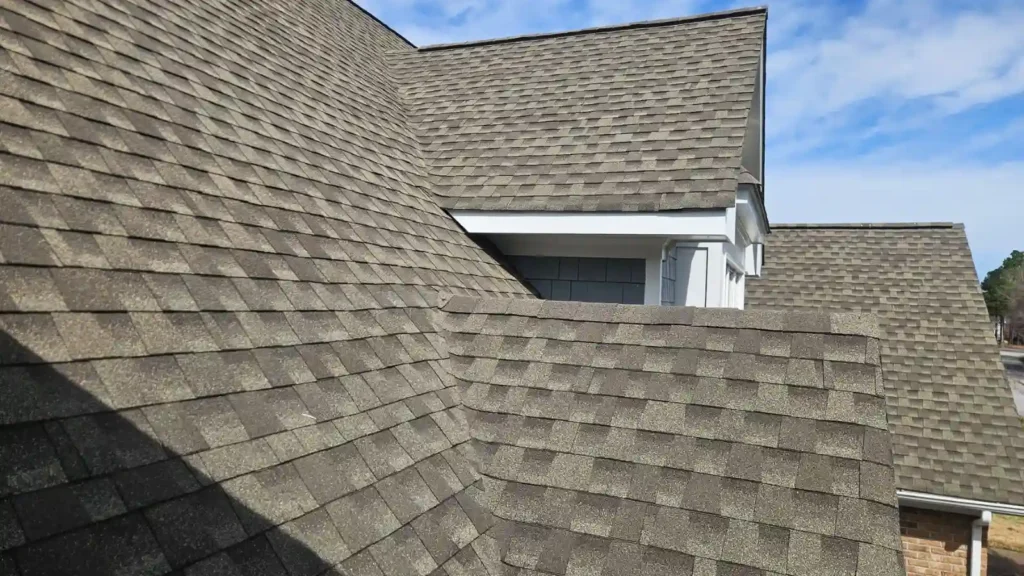
The hip roof replaces the flat gable ends of a gable roof with additional sloped planes that angle down from the ridge to the eave on all four sides of the building. This geometry distributes wind loading more evenly around the roof perimeter and produces significantly better wind resistance than a comparable gable roof in storm conditions. Hip roofs are the standard specification in hurricane zones and coastal markets and command a meaningful insurance premium discount in those areas. Their additional complexity relative to gable roofs increases both the installation cost and the number of valley and hip intersections that require careful flashing detail.
Residential Roofing Materials and Their Style Compatibility
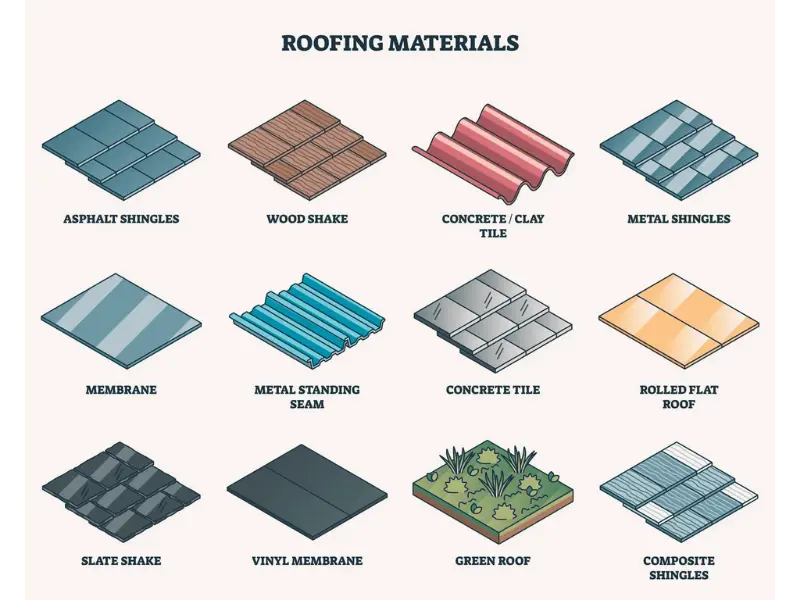
The roofing material selected for a residential roof must be compatible with both the roof shape’s pitch and the structural loading capacity of the framing system beneath it. Asphalt shingles are the most widely installed residential roofing material in North America and are compatible with any pitched roof form with a minimum slope of 2 in 12 with self-adhered underlayment or 4 in 12 for standard installation. They are available in three-tab and architectural dimensional profiles that work across all standard residential roof shapes at a cost and weight profile that requires no special structural consideration in most residential framing configurations.
Metal roofing in standing seam and exposed fastener panel profiles is compatible with the full range of residential roof pitches from low slope at 1 in 12 for standing seam systems down to near-flat applications, through steep pitches where its light weight and positive drainage characteristics produce strong performance. Metal’s lightweight relative to tile and slate makes it compatible with a wider range of residential framing conditions without structural upgrade, and its longevity of 40 to 70 years makes it a compelling lifecycle cost selection for homeowners who factor replacement frequency into the cost comparison.
Clay and concrete tile are compatible with medium to steep pitch roof forms,s including gable, hip, and mansard styles at pitches from 4 in 12 and above. Its weight, typically 900 to 1,200 pounds per square, requires structural engineering confirmation before installation on any roof not originally designed for tile loading. Tile provides exceptional durability of 50 years or more and is the standard material specification in Mediterranean, Spanish colonial, and Southwest architectural styles.
Choosing the Right Residential Roofing Style: Step-by-Step
Selecting the right residential roofing style requires working through a defined sequence that narrows the field from all possible options to the correct combination for the specific home, climate, and budget.
Step 1: Confirm the existing roof structure’s pitch and load capacity before evaluating materials.
Measure the existing roof pitch before considering any material that has a minimum pitch requirement or a weight that differs from the existing roofing material. A pitch below 4 in 12 eliminates standard asphalt shingle installation and requires a low-slope membrane system. A switch from asphalt to tile requires a structural engineer’s confirmation that the framing can support the additional weight.
Step 2: Identify the climate-driven performance requirements for the specific location.
High-wind and hurricane zones require hip roof geometry, minimum fastener specifications, and wind-rated materials. High-snowfall climates require steep pitches that shed snow load aice-dam-resistantant underlayment systems. High-rainfall climates require drainage-efficient shapes and materials with proven watertight lap details. Arid climates with high UV exposure favor tile and metal over asphalt for their superior UV resistance.
Step 3: Confirm any HOA, municipal, or historic district requirements before finalizing material selection.
Many residential communities specify approved roofing materials, colors, and profiles in their CC&R documents. Historic districts frequently restrict replacement materials to those consistent with the home’s architectural period. Confirming these requirements before purchasing materials prevents costly scope reversals after installation has begun.
Step 4: Compare lifecycle cost across the shortlisted material options rather than the installed price alone.
Calculate the cost per year of expected service life for each candidate material by dividing the installed cost by the expected lifespan. Add the energy performance differential between options and the maintenance cost differential over the expected service period to complete a meaningful comparison that reflects total ownership cost rather than purchase price.
Step 5: Solicit three competitive bids against a defined specification for the selected style and material.
Competitive bids developed against an identical specification allow direct price comparison without the distortion of comparing proposals built on different material grades, underlayment specifications, or warranty terms.
Residential Roofing Style and Material Compatibility Reference
| Roof Shape | Minimum Pitch | Compatible Materials | Incompatible Materials |
|---|---|---|---|
| Gable | 2 in 12 | Asphalt, metal, tile, slate, shake, synthetic | Flat membrane below 2 in 12 |
| Hip | 4 in 12 | Asphalt, metal, tile, slate, shake, synthetic | Flat membrane |
| Gambrel | 3 in 12 | Asphalt, metal, shake, synthetic | Heavy tile on lower slope below 4 in 12 |
| Mansard | 2 in 12 upper, 7 in 12 lower | Metal, modified bitumen upper, tile or slate lower | Standard shingle on flat upper section |
| Flat or low slope | 0 to 2 in 12 | TPO, EPDM, modified bitumen, BUR, SPF | Asphalt shingles, tile, slate, shake |
| Shed or skillion | 1 in 12 | Metal standing seam, membrane, asphalt above 2 in 12 | Tile, slate on pitches below 4 in 12 |
Common Residential Roofing Style Mistakes to Avoid
Selecting a roofing material based on visual appearance in a showroom or online without confirming its compatibility with the existing roof pitch is the most common and most immediately consequential roofing style mistake homeowners make. Asphalt shingles installed on a roof with a pitch below the manufacturer’s minimum requirement leak at every lap joint during normal rainfall because the pitch is insufficient to prevent water from backing up under the shingle above. Material selection must always begin with pitch confirmation, not with aesthetic preference.
Choosing a roofing style based on the lowest installed price without considering the replacement cycle cost is the residential equivalent of buying the cheapest tires available without accounting for how often they will need to be replaced. A 20-year asphalt shingle installed at $8,000 on a home the owner plans to hold for 40 years costs $16,000 over the holding period. A 40-year metal roof installed at $18,000 on the same home costs $18,000 once.
The metal system costs more at installation and less over the period the home is actually owned, a calculation that most homeowners do not complete before making the material selection that determines their roofing costs for decades.
Installing heavy tile or slate on a residential structure without a structural engineer’s load assessment, because the existing roof looks solid,d introduces structural risk that is not visible until deflection, cracking, or rafter failure occurs. Residential framing designed for asphalt shingles carries a live and dead load allowance that tile and slate routinely exceed by 500 to 800 pounds per square. The structural assessment cost of $300 to $600 is not optional on any tile or slate installation on a home not originally designed for that material weight.
Ignoring the gable end bracing requirement for homes in high-wind zones that are replacing a roof with a gable configuration, installing a new roof on a structural vulnerability that made the previous roof susceptible to wind damage. Modern building codes in wind zones require specific gable end bracing and panel nailing patterns that may not have been present in the original construction. A replacement project is the opportunity to correct this deficiency rather than replicate it.
Selecting a complex multi-plane roof form on a new construction or addition project without accounting for the increased valley, hip, and ridge flashing complexity in the roofing budget understates the true cost of that form by 15 to 30 percent relative to a simpler gable or hip geometry that uses the same materials over the same footprint.
Residential Roofing Style Performance Benchmarks by Age
The performance characteristics and maintenance requirements of a residential roofing style shift at predictable intervals based on both the roof shape and the material installed. Roofs of any style in their first 0 to 5 years should be performing at full design capacity with minimal maintenance required if correctly installed. The most common early-stage issues are installation defects,cts including improper valley flashing at intersecting planes, inadequate fastener patterns on steep pitches, and missing or incorrectly installed underlayment at vulnerable transition points.
Between 5 and 10 years, the first meaningful maintenance cycle begins across all residential roofing styles and materials. Asphalt shingle sealant strip adhesion begins to age, metal panel fastener seals require inspection, tile mortar at ridge caps begins to show weathering, and flashing sealants at all roof shape transitions approach the end of their first reliable service cycle. Annual inspection from year seven onward is appropriate for all residential roofing styles regardless of material type.
At 10 to 15 years, the performance differential between roofing styles and materials becomes measurable. Gable roofs in high-wind climates that were installed without adequate bracing show more cumulative damage than hip roofs exposed to the same storm history. Asphalt shingles in high-UV climates show significantly more granule loss than the same product installed in moderate climates. Material-specific replacement planning should begin in this window for asphalt systems in demanding climates.
Technology Tools Homeowners Can Use
Modern tools make residential roofing style research, cost comparison, and contractor evaluation more accessible and more precise than traditional methods. Augmented reality roofing visualization apps offered by major shingle and metal roofing manufacturers allow homeowners to photograph their home and digitally overlay different roofing styles, materials, and colors in real scale before purchasing, eliminating the guesswork that produces regretted aesthetic decisions after installation is complete.
Satellite roof measurement platforms generate accurate pitch, square footage, and geometry data for any residential address, allowing homeowners to confirm the measurements used in contractor quotes and to calculate material quantities independently before comparing proposals.
DIY Assessment vs. Professional Installation: Know the Difference
Homeowners can independently research roofing style compatibility with their home’s architectural period, confirm pitch measurements using a smartphone-based pitch gauge app, verify HOA and municipal material requirements from governing documents, use visualization tools to evaluate aesthetic options, and compare lifecycle cost across candidate materials before engaging any contractor. These research and planning tasks require no roofing expertise and produce a more informed homeowner who can evaluate contractor proposals with a genuine understanding rather than relying entirely on the recommending contractor’s judgment.
However, structural load assessment for heavy materials, pitch measurement on steeply pitched or multi-plane roof forms, flashing design at complex valley and hip intersections, underlayment specification for climate-specific performance requirements, and all physical installation work on any residential roof require a licensed roofing contractor with documented experience in the specific material and roof form being installed.
Roofing style decisions that involve changes to the roof structure, including adding dormers, changing roof pitch, converting a gable to a hip configuration, or installing a green roof system, require both a licensed contractor and a structural engineer whose stamp confirms that the modified structure meets current code requirements.
Seek immediate professional attention if any existing roof shows active structural deflection visible as sagging between rafters or at the ridge line, if a material change is being considered that would add more than 200 pounds per square to the existing loading, or if the home is located in a wind zone, seismic zone, or wildfire interface area where material and installation specifications have mandatory code requirements that must be confirmed before any roofing work begins.
Final Thoughts
Residential roofing styles are a decision that rewards homeowners who approach it as the multi-decade performance and financial commitment it actually is, rather than a cosmetic upgrade that can be reconsidered in a few years.
The right roof shape for the climate, the right material for the pitch and structure, and the right lifecycle cost comparison against the expected holding period of the home are the three calculations that produce a roofing decision that looks right, performs correctly, and costs what the homeowner planned to spend over the full service life of the system. Those calculations take an afternoon to complete. The alternative is discovering what they would have shown after the roof is already installed.
FAQs
1. What is the most durable residential roofing style and material combination?
A: A hip roof with metal standing seam or slate delivers the longest combined service life. Hip geometry provides superior wind resistance,e and metal or slate materials last 40 to 150 years, rs respectively.
2. Which residential roofing style is best for high-wind and hurricane zones?
A: Hip roofs consistently outperform gable roofs in high-wind conditions. The four-sided slope distributes wind load evenly and eliminates the flat gable end that acts as a sail in high-wind events.
3. Can I install any roofing material on any roof shape?
A: No. Minimum pitch requirements eliminate asphalt shingles, tile, and slate from flat and low-slope applications. Heavy materials require structural confirmation before installation on any home not originally designed for that load.
4: How does roof shape affect my homeowners’ insurance premium?
A: Hip roofs qualify for wind mitigation discounts of 20 to 45 percent in hurricane-prone states. Impact-resistant Cla4-rated materials add further premium reductions of 15 to 30 percent in hail-prone markets.
5: What residential roofing style adds the most resale value?
A: A style consistent with the home’s architectural period, installed in a material at or above neighborhood median quality with significant remaining service life, consistently produces the strongest appraisal impact and buyer perception value.