Roof ventilation Virginia homes is a topic that deserves more attention than most Old Dominion homeowners give it, primarily because Virginia’s climate does not fit neatly into either the cold northern ventilation model or the hot southern one. Virginia spans four distinct climate zones from the coastal Tidewater region through the Piedmont plateau and into the Blue Ridge and Appalachian mountain counties, and the ventilation system that performs correctly in Norfolk is not the same one that protects a home in Roanoke or Winchester.
Getting roof ventilation wrong in Virginia means paying for it twice, once through elevated cooling bills in the summer and again through ice dam damage, mold remediation, or premature shingle failure in the seasons that follow. Understanding what correct roof ventilation looks like for Virginia’s specific climate profile, what the signs of inadequate ventilation are, and what the right system components are for each region of the state gives Virginia homeowners the foundation for a roofing system that performs correctly year-round. This guide covers everything you need to know.
What is Roof Ventilation Virginia Homes? (The Simple Definition)
Roof ventilation Virginia homes is the system of intake and exhaust components installed in the roofing assembly that creates continuous airflow through the attic space, removing heat and moisture vapor before they accumulate to levels that damage roofing materials, structural components, and interior finishes. A properly ventilated Virginia roof draws cool outside air in through soffit vents at the eave line, moves it up through the attic across the underside of the roof deck, and exhausts it through ridge vents, roof louvers, or power vents at or near the peak of the roof.
Virginia’s mixed-humid climate classification means the ventilation system must perform two distinct jobs depending on the season. In summer, it must exhaust superheated attic air that routinely reaches 140 to 160 degrees Fahrenheit in the Piedmont and Tidewater regions, reducing the thermal load on HVAC systems and the heat stress on shingles from below. In winter, it must keep the attic cold enough to match exterior roof surface temperature, preventing the freeze-thaw cycling that causes ice dams in the Northern Virginia, Shenandoah Valley, and Blue Ridge mountain communities.
Virginia Roof Ventilation Requirements by Region
| Virginia Region | Climate Challenge | Primary Ventilation Priority | Recommended System |
|---|---|---|---|
| Tidewater and Hampton Roads | High humidity, summer heat, salt air | Moisture exhaust, heat reduction | Continuous ridge and soffit with corrosion-resistant components |
| Northern Virginia and DC metro | Cold winters, hot, humid summers, ice dam risk | Balanced year-round heat and moisture management | Ridge and soffit with ice and water shield at eaves |
| Shenandoah Valley | Cold winters, moderate summers, freeze-thaw cycles | Cold attic in winter, heat exhaust in summer | Ridge vent with full soffit intake, no power vents |
| Piedmont and Central Virginia | Hot, humid summers, moderate winters | Summer heat exhaust, humidity control | Continuous ridge and soffit, consider a power vent supplement |
| Blue Ridge and Southwest Virginia | High snowfall, severe freeze-thaw, and high UV at elevation | Ice dam prevention, moisture control | Ridge vent, ice and water shield, attic air sealing priority |
| Eastern Shore | High humidity, wind exposure, and salt corrosion | Moisture management, corrosion resistance | Stainless or aluminum vents, continuous soffit |
Virginia’s regional variation is significant enough that a ventilation system specified without accounting for the specific county and elevation of the home will consistently underperform for at least half the year, regardless of how well it is installed.
Why Roof Ventilation Matters for Virginia Homes (The Real Cost Breakdown)
The consequences of inadequate roof ventilation in Virginia are specific to the state’s climate profile and more varied than in single-climate states. In the Tidewater and Piedmont regions, summer attic temperatures in an unventilated or under-ventilated attic routinely reach 150 to 160 degrees Fahrenheit during July and August. This heat radiates downward through the ceiling into living spaces, increasing cooling loads by 10 to 25 percent depending on insulation levels.
It simultaneously radiates upward through the roof deck and bakes asphalt shingles from below, accelerating granule loss and sealant strip degradation at a rate that can reduce an expected 25-year shingle lifespan to 15 to 18 years in Virginia’s summer heat profile. Replacing a Virginia roof five to seven years early because of heat-accelerated shingle degradation costs $9,000 to $20,000 on a standard residential system, a cost that correct ventilation largely prevents.
In Northern Virginia, the Shenandoah Valley, and the Blue Ridge counties, the winter consequences of poor ventilation are equally significant. When the attic temperature exceeds freezing because heat escapes from the living space below through inadequate insulation and air sealing, the roof deck warms above 32 degrees while the eave overhang remains below freezing. Snowmelt running down the warm deck refreezes at the cold eave, building the ice dam that backs water under shingles and into the attic and wall cavity.
Ice dam interior damage in Virginia hill country homes runs $3,000 to $12,000 per event and can repeat every winter on a home with inadequate ventilation until the underlying heat loss is corrected. The humidity component of Virginia’s climate adds a third consequence across all regions: moisture vapor rising from the living space into an inadequately ventilated attic condenses on the cold underside of the roof deck in winter and on any surface cooler than the dewpoint in the humid summer months, saturating insulation, staining sheathing, and creating the conditions for mold growth that costs $3,000 to $10,000 to remediate and recurs until the ventilation is corrected.
Virginia’s Climate Zones and What They Mean for Roof Ventilation
Virginia’s geography creates three meaningfully distinct ventilation environments that require different system emphases, and identifying which environment applies to a specific home is the first step in specifying or assessing any ventilation system. The coastal and Tidewater zone covering Hampton Roads, Virginia Beach, the Eastern Shore, and the lower peninsula combines high relative humidity year-round with summer temperatures that drive attic heat loads as high as anywhere in the mid-Atlantic region.
The primary ventilation challenge in this zone is simultaneous heat and moisture management, and the secondary challenge is corrosion resistance. Salt-laden coastal air corrodes standard galvanized steel vents, ridge cap fasteners, and attic ventilation components faster than inland environments, making aluminum, stainless steel, and polymer vent components the appropriate specification for any coastal Virginia installation.
Correct Roof Ventilation Components for Virginia Homes: Step-by-Step
Building or assessing a correct roof ventilation system for a Virginia home requires confirming that each component is present, correctly sized, and functioning in the sequence that creates continuous attic airflow.
Step 1: Calculate the required net free ventilation area for the attic.
Virginia building code follows the IRC requirement of one square foot of net free ventilation area per 150 square feet of attic floor space, split equally between intake at the soffit and exhaust at the ridge. For a 1,500 square foot attic, this requires 10 square feet of total net free area, or 5 square feet each of intake and exhaust. Confirm that the installed soffit and ridge vent products deliver this area by checking the manufacturer’s rated net free area rather than assuming that the presence of vents equals adequate ventilation.
Step 2: Confirm that soffit intake vents are unobstructed by insulation.
Access the attic and check the eave zone where the insulation meets the soffit vent opening. In many Virginia homes, blown insulation has migrated to cover the soffit vent area, either partially or completely blocking intake airflow. Rafter vent baffles installed between each rafter pair from the eave to a point above the insulation depth maintain the intake channel and must be present and uncompressed for the ventilation system to function as designed.
Step 3: Confirm that ridge vent coverage extends the full length of the ridge line.
A ridge vent that covers only a portion of the ridge line creates uneven exhaust distribution across the attic, leaving ventilation dead zones between the active vent section and the gable ends. In Virginia homes with complex roof forms, including multiple ridge lines, dormers, and intersecting hip sections, confirming that the exhaust vent coverage addresses the full attic volume requires a roof-level inspection of every ridge section.
Step 4: Eliminate any combination of ridge vents and gable vents that creates short-circuit airflow.
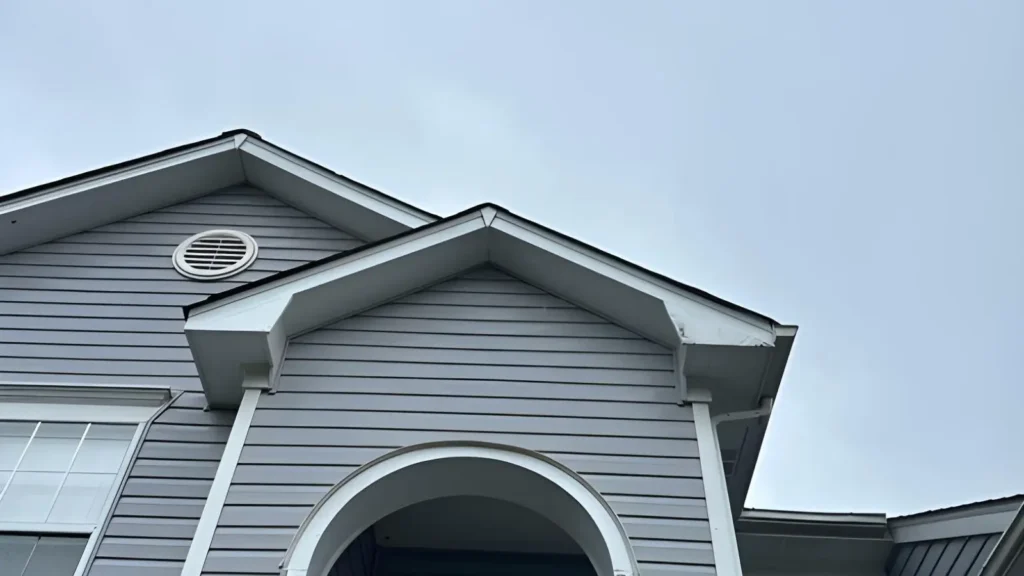
In many older Virginia homes, gable vents were the original ventilation solution, and ridge vents were added during a re-roofing project without removing the gable vents. When both systems are active simultaneously, the gable vents allow cross-ventilation that short-circuits the vertical stack effect the ridge and soffit system depends on, drawing air through the gable vents rather than up from the soffits and reducing the ventilation effectiveness of the entire system. Seal existing gable vents when a ridge and soffit system is installed to eliminate this interference.
Step 5: Install ice and water shield underlayment at eaves in Northern Virginia and mountain zone homes.
Virginia homes in IECC climate zones 4 and 5, which cover Northern Virginia, the Shenandoah Valley, and the Blue Ridge, are required by the current Virginia Residential Code to install self-adhering ice and water shield underlayment at the eave extending at least 24 inches inside the warm wall line. This secondary protection prevents ice dam water entry through the eave shingles during winter events when the ventilation system alone cannot prevent ice dam formation during extended cold spells.
Step 6: Address attic air sealing before assuming ventilation alone solves moisture and ice dam problems.
In Virginia mountain zone homes, attic ventilation corrects the symptom of inadequate thermal separation between the living space and the attic, but air sealing at the ceiling plane corrects the cause. Sealing penetrations around can lights, plumbing vents, electrical boxes, and attic access hatches dramatically reduces the volume of warm, humid air entering the attic above the insulation, reducing both the moisture load on the ventilation system and the heat input that drives ice dam formation.
Step 7: Schedule annual attic inspections to confirm ventilation system performance.
Virginia’s seasonal climate transitions create conditions that degrade ventilation component performance in ways that develop gradually and are not visible from outside the home. Soffit vent screen corrosion in coastal areas, insulation migration at eave baffles in all regions, and ridge vent mesh clogging from pollen and debris in the Piedmont oak forest zones are all conditions that reduce system performance below the design specification and require annual confirmation that the full intake-to-exhaust pathway is open and functioning.
Common Roof Ventilation Mistakes Virginia Homeowners Make
Installing more exhaust ventilation than intake ventilation is the most widespread ventilation error in Virginia residential construction and the one that most directly contradicts the physics of attic airflow. When exhaust capacity exceeds intake capacity, the negative pressure created inside the attic draws conditioned air from the living space through ceiling penetrations rather than outside air through soffit vents.
The result is an attic that exhausts heated or cooled air the homeowner paid to condition, increases HVAC operating cost, and still fails to achieve the fresh air exchange the ventilation system was designed to provide. Every Virginia roof ventilation system must balance exhaust capacity against intake capacity before either component is sized.
Adding power attic ventilators to a Virginia home as a summer cooling measure without confirming that the soffit intake area is adequate to supply the power vent’s airflow demand creates the same negative pressure problem described above, but at an amplified scale. Power vents that draw more air than the soffit vents can supply depressurize the attic significantly, pulling conditioned air from the living space through every penetration in the ceiling plane.
In Virginia’s humid summers, this conditioned air carries moisture vapor that condenses in the attic space, creating the moisture problem the ventilation was intended to prevent. Power vents should be specified only after confirming that the soffit intake area meets or exceeds the power vent’s rated airflow demand.
Roof Ventilation Performance Benchmarks for Virginia Homes by Roof Age
The ventilation system performance and maintenance needs of a Virginia home shift predictably as the roof assembly ages. Roofs 0 to 5 years old in Virginia should be performing at full ventilation design capacity if installed to the current Virginia Residential Code requirements. The most common early-stage ventilation failures are installation defects, including baffles omitted during insulation installation, ridge vent slots cut too narrow in the deck, and soffit vents painted over during exterior repaints that reduce the net free area below the design specification.
Between 5 and 10 years, Virginia’s coastal and Tidewater homeowners should inspect all metal soffit and ridge vent components for corrosion that reduces net free area at the screen and louver level. The salt air and high-humidity environment degrade standard galvanized steel ventilation components faster than inland applications, and the first visible corrosion at screen edges indicates that the net free area is already being reduced.
At 10 to 15 years, ridge vent mesh in Virginia’s Piedmont and Northern Virginia oak forest zones commonly accumulates enough pollen, seed debris, and organic matter to meaningfully reduce net free exhaust area. Annual clearing of ridge vent mesh is a high-value maintenance action in these regions that costs almost nothing and prevents the progressive ventilation reduction that occurs when debris accumulation is allowed to continue unchecked.
Technology Tools Virginia Homeowners Can Use
Modern tools give Virginia homeowners more capability to assess and verify roof ventilation performance than was available in previous years. Thermal imaging cameras or smartphone-attachable thermal sensors allow homeowners to scan the attic interior during peak summer afternoon hours and identify hot zones where ventilation airflow is insufficient, mapping the thermal performance of the ventilation system across the full attic volume rather than inferring it from vent presence alone.
Attic humidity dataloggers placed in the attic interior record temperature and relative humidity continuously through multiple seasonal transitions, producing a documented record of whether the ventilation system is maintaining conditions within the ranges that prevent condensation, mold growth, and shingle heat damage.
DIY Assessment vs. Professional Installation: Know the Difference
Virginia homeowners can safely perform a meaningful roof ventilation assessment without professional help. Accessing the attic with a flashlight to check for unobstructed soffit vent openings, confirm that rafter vent baffles are present at the eave zone, observe any condensation staining on the underside of the roof deck, check for daylight visible through the full length of the ridge vent slot, and count the installed vent units against the calculated requirement are all homeowner tasks that require no roofing expertise and produce a reliable picture of whether the ventilation system is functioning as designed.
However, cutting additional ridge vent slots in an existing deck, installing or replacing soffit vent panels in continuous vinyl or aluminum soffit systems, adding rafter vent baffles in an attic with existing dense-pack insulation, sealing attic penetrations in a home with complex mechanical equipment access requirements, and any ventilation work on a steeply pitched Virginia mountain home should be performed by a licensed Virginia roofing or insulation contractor with documented experience in the specific ventilation system type and climate zone.
Virginia roofing contractors are licensed through the Virginia Department of Professional and Occupational Regulation, and confirming active license status before any ventilation work authorization takes two minutes and eliminates the qualification risk that produces improperly installed ventilation systems that perform below design specifications.
Final Thoughts
Roof ventilation Virginia homes is not a one-size solution applied uniformly across a state whose climate ranges from near-coastal subtropical conditions in Virginia Beach to alpine conditions in the Blue Ridge Highlands. The homeowner who identifies their specific Virginia climate zone, confirms their attic ventilation net free area against the calculated requirement, checks that intake and exhaust are balanced and unobstructed, and inspects the attic annually for the seasonal performance signals that indicate a developing problem is managing one of the most consequential but least visible systems in the entire home.
Virginia’s climate demands that the ventilation system work correctly in summer heat, winter cold, and the humid transitions between them. The annual attic inspection that confirms it costs an hour and a flashlight. The alternative costs a great deal more.
FAQs
1. Why is roof ventilation especially important for Virginia homes?
A: Virginia spans multiple climate zones requiring ventilation to manage both summer attic heat reaching 150 plus degrees and winter ice dam risk in mountain and Northern Virginia counties simultaneously.
2. How much ventilation does a Virginia home’s attic need?
A: One square foot of net free ventilation area per 150 square feet of attic floor space, split equally between soffit intake and ridge exhaust. A 1,500 sq ft attic requires 10 total square feet of net free area.
3. Do I need ice and water shield if I have good roof ventilation in Virginia?
A: Yes, in Northern Virginia, Shenandoah Valley, and Blue Ridge counties. Virginia code requires ice and water shield at eaves in climate zones 4 and 5, regardless of ventilation system quality.
4. Can I have too much roof ventilation in a Virginia home?
A: Yes, if exhaust exceeds intake. Unbalanced ventilation creates negative attic pressure that draws conditioned air from the living space, increasing energy costs and introducing moisture to the attic.
5. Should I remove my gable vents if I install a ridge and soffit system in Virginia?
A: Yes. Active gable vents short-circuit the stack effect that the ridge and soffit system depends on, drawing cross-ventilation air instead of vertical flow from soffit to ridge. Seal gable vents when upgrading to ridge and soffit.